


Page 45 - ACE YR IGCSE A TOP APPROACH TO CHEM
P. 45
(e) Use pH meter / universal indicator [1] 4 (a) More than enough [1]
pH 1 – 3: A strong acid / red [1] (b) To ensure all of the acid has reacted [1]
pH 4 – 6: A weak acid / yellow / orange [1]
All of the acid must be reacted to get pure crystals.
(c) The solid dissolved. [1]
The solution turned blue. [1]
Copper(II) oxide is a black solid. It will dissolve when
it reacts with the acid to form a soluble copper(II)
sulfate. Aqueous copper(II) sulfate solution is blue.
(d) Copper(II) oxide [1]
An excess of the solid is added. Therefore, the
or residue is copper(II) oxide.
Penerbitan Pelangi Sdn Bhd. All Rights Reserved.
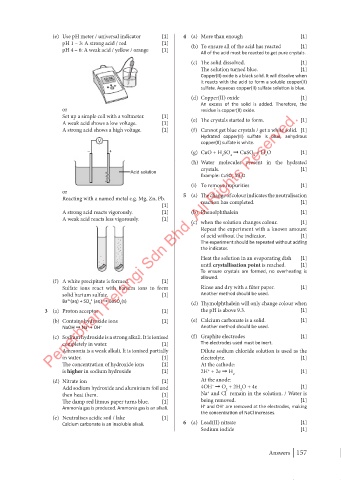
Set up a simple cell with a voltmeter. [1]
A weak acid shows a low voltage. [1] (e) The crystals started to form. [1]
A strong acid shows a high voltage. [1] (f) Cannot get blue crystals / get a white solid. [1]
Hydrated copper(II) sulfate is blue, anhydrous
V copper(II) sulfate is white.
– + (g) CuO + H SO ➞ CuSO + H O [1]
2
4
2
4
(h) Water molecules present in the hydrated
crystals. [1]
Acid solution
Example: CuSO .5H O
4 2
(i) To remove impurities [1]
or 5 (a) The change of colour indicates the neutralisation
Reacting with a named metal e.g. Mg, Zn, Pb. reaction has completed. [1]
[1]
A strong acid reacts vigorously. [1] (b) Phenolphthalein [1]
A weak acid reacts less vigorously. [1]
(c) when the solution changes colour. [1]
Repeat the experiment with a known amount
of acid without the indicator. [1]
The experiment should be repeated without adding
the indicator.
Heat the solution in an evaporating dish [1]
until crystallisation point is reached. [1]
To ensure crystals are formed, no overheating is
allowed.
(f) A white precipitate is formed. [1]
Sulfate ions react with barium ions to form Rinse and dry with a filter paper. [1]
solid barium sulfate. [1] Another method should be used.
Ba (aq) + SO (aq) ➞ BaSO (s)
2–
2+
4 4 (d) Thymolphthalein will only change colour when
3 (a) Proton acceptor [1] the pH is above 9.3. [1]
(b) Contains hydroxide ions [1] (e) Calcium carbonate is a solid. [1]
NaOH ➞ Na + OH – Another method should be used.
+
(c) Sodium hydroxide is a strong alkali. It is ionised (f) Graphite electrodes [1]
completely in water. [1] The electrodes used must be inert.
Ammonia is a weak alkali. It is ionised partially Dilute sodium chloride solution is used as the
in water. [1] electrolyte. [1]
The concentration of hydroxide ions [1] At the cathode:
is higher in sodium hydroxide [1] 2H + 2e ➞ H [1]
+
2
(d) Nitrate ion [1] At the anode:
–
Add sodium hydroxide and aluminium foil and 4OH ➞ O + 2H O + 4e [1]
2
2
–
+
then heat them. [1] Na and Cl remain in the solution. / Water is
The damp red litmus paper turns blue. [1] being removed. [1]
+
–
Ammonia gas is produced. Ammonia gas is an alkali. H and OH are removed at the electrodes, making
the concentration of NaCl increases.
(e) Neutralises acidic soil / lake [1]
Calcium carbonate is an insoluble alkali. 6 (a) Lead(II) nitrate [1]
Sodium iodide [1]
Answers 157
Answers.indd 157 3/4/22 3:54 PM

