


Page 33 - Ranger SPM 2022 - Science
P. 33
Science SPM  Chapter 6 Electrochemistry
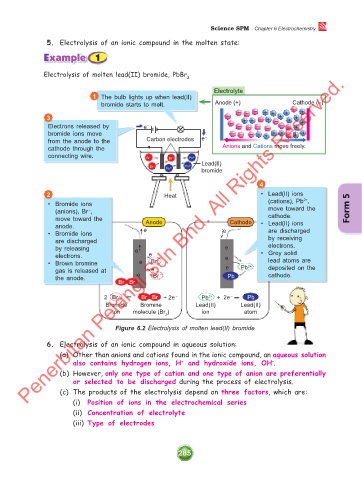
                   5.  Electrolysis of an ionic  compound in the molten state:
                  Example       1

                  Electrolysis of molten lead(II) bromide,  PbBr 2
                    Penerbitan Pelangi Sdn Bhd. All Rights Reserved.

                                                                Electrolyte
                               1  The bulb lights up when lead(II)
                                 bromide starts to melt.         Anode (+)            Cathode (–)
                                                                                      –
                                                                              + +
                  3                                                 –  – –  + –  – +  –  +  + +  +  +
                                                                        +
                   Electrons released by     e –                     –  –  –  –  –  – – +  +
                   bromide ions move                                 –  –  – +  +  +  +  – +  +
                   from the anode to the      Carbon electrodes  e –
                   cathode through the                             Anions and Cations move freely.
                   connecting wire.           Br –  Br –  Pb 2+
                                                             Lead(II)
                                               Br –     Pb 2+
                                                   Pb 2+     bromide
                                                                             4
                  2                                Heat                      •  Lead(II) ions
                                                                                         2+
                   •  Bromide ions                                             (cations), Pb ,
                     (anions), Br  ,                                           move toward the        Form 5
                              –
                     move toward the          Anode                  Cathode   cathode.
                     anode.                                                  •  Lead(II) ions
                   •  Bromide ions           e                     e           are discharged
                     are discharged                                            by receiving
                     by releasing          e                        e          electrons.
                     electrons.                e                    e        •  Grey solid
                   •  Brown bromine         e  Br –                       2+   lead atoms are
                     gas is released at        e                    e   Pb     deposited on the
                     the anode.            e    Br –                Pb         cathode.
                                      Br Br
                                  2 Br –    Br Br  + 2e  –   Pb 2+  +  2e  –  Pb
                                   Bromide  Bromine        Lead(II)     Lead(II)
                                    ion   molecule (Br )     ion         atom
                                                   2
                                     Figure 6.2 Electrolysis of molten lead(II) bromide

                   6.  Electrolysis of an ionic  compound in aqueous solution:
                       (a)  Other than anions and cations found in the ionic compound, an aqueous solution
                          also  contains  hydrogen  ions,  H   and  hydroxide  ions,  OH .
                                                                                –
                                                       +
                       (b)  However, only one type of cation and one type of anion are preferentially
                          or  selected  to  be  discharged during  the process of electrolysis.
                       (c)  The products of the electrolysis depend  on  three factors, which are:
                          (i)  Position of  ions in the  electrochemical  series
                          (ii)  Concentration  of  electrolyte
                          (iii)  Type  of electrodes


                                                       285


         F5 Chapter 6.indd   285                                                              3/21/22   3:59 PM

