


Page 37 - Ranger SPM 2022 - Science
P. 37
Science SPM  Chapter 6 Electrochemistry
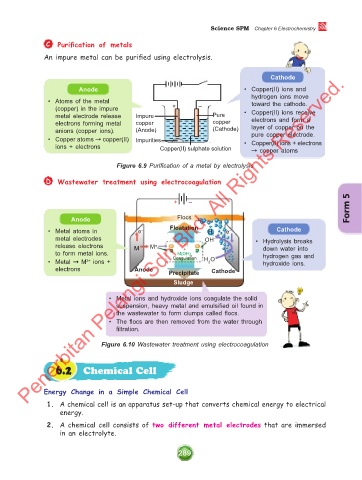
                  C   Purification  of  metals

                  An impure metal can be purified  using electrolysis.

             Penerbitan Pelangi Sdn Bhd. All Rights Reserved.
                                                                                Cathode
                           Anode                                         •  Copper(II) ions and
                                                                           hydrogen ions move
                   •  Atoms of the metal                                   toward the cathode.
                     (copper) in the impure          +      –            •  Copper(II) ions receive
                     metal electrode release   Impure           Pure       electrons and form a
                     electrons forming metal   copper           copper
                     anions (copper ions).  (Anode)             (Cathode)  layer of copper on the
                                                                           pure copper electrode.
                   •  Copper atoms ➞ copper(II)   Impurities             •  Copper(II) ions + electrons
                     ions + electrons             Copper(II) sulphate solution  ➞ copper atoms

                                      Figure 6.9 Purification of a metal by electrolysis

                  D   Wastewater  treatment  using  electrocoagulation

                                                                                                      Form 5
                                                     +    –

                         Anode                        Flocs
                   •  Metal atoms in        e –     Floatation  H 2  e –          Cathode
                     metal electrodes                         OH –          •  Hydrolysis breaks
                     release electrons    M    M n     OH                     down water into
                                                        +
                     to form metal ions.              M(OH) n                 hydrogen gas and
                   •  Metal ➞ M  ions +              Coagulation  H O         hydroxide ions.
                             2+
                                                               2
                     electrons             Anode    Precipitate  Cathode
                                                     Sludge
                                    •  Metal ions and hydroxide ions coagulate the solid
                                      suspension, heavy metal and emulsified oil found in
                                      the wastewater to form clumps called flocs.
                                    •  The flocs are then removed from the water through
                                      filtration.

                                 Figure 6.10 Wastewater treatment using electrocoagulation


                     6.2    Chemical Cell


                  Energy  Change  in  a  Simple  Chemical  Cell
                   1.  A chemical cell is an apparatus set-up that converts chemical energy to electrical
                      energy.
                   2.  A  chemical cell consists of two  different  metal  electrodes that are immersed
                      in  an electrolyte.


                                                       289


         F5 Chapter 6.indd   289                                                              3/21/22   3:59 PM

