


Page 20 - Focus SPM KSSM Tg 4.5 - Add Maths
P. 20
Additional Mathematics SPM Chapter 2 Quadratic Functions
19 • For the case a 0, the vertex (h, k) is a
maximum point and k is the maximum value
Show that the straight line y = 2x – 1 intersects the of f(x).
curve of the graph of f (x) = 3x – 4x + q at one point
2
for q = 2. 3. The method of completing the squares is used
to change f(x) = ax + bx + c to the vertex
2
Solution b
2
y = 2x – 1 ...............................................1 form f(x) = a(x – h) + k where h = – 2a and
2
f (x) = 3x – 4x + q .....................................2 4ac – b 2
k = .
2 = 1 at the point of intersection, 4a
3x – 4x + q = 2x – 1
2
3x – 6x + q + 1 = 0 a = 3, b = –6 and c = q + 1 4. By using the factorisation method or the
2
quadratic formula, functions in the general form Form 4
There is only one point of intersection: f(x) = ax + bx + c can be changed to the intercept
2
b – 4ac = 0 form f(x) = a(x – p)(x – q) where p and q are the
2
(–6) – 4(3)(q + 1) = 0 roots of f(x).
2
36 – 12q – 12 = 0
24 – 12q = 0
12q = 24 Steps of deriving
q = 2 Formula of Vertex
Form
INFO
Try Question 11 in ‘Try This! 2.3’
20
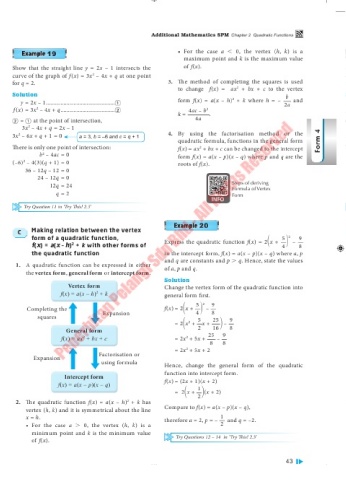
C Making relation between the vertex
form of a quadratic function, Express the quadratic function f(x) = 2 x + 5 2 –
9
f(x) = a(x – h) + k with other forms of 4 8
2
the quadratic function in the intercept form, f(x) = a(x – p)(x – q) where a, p
and q are constants and p . q. Hence, state the values
1. A quadratic function can be expressed in either of a, p and q.
the vertex form, general form or intercept form.
Solution
Vertex form Change the vertex form of the quadratic function into
f(x) = a(x – h) + k general form first.
2
Completing the Expansion f(x) = 2 x + 5 4 2 – 9
8
squares 5 25 9
= 2 x + x + –
2
General form 2 16 8
f(x) = ax + bx + c = 2x + 5x + 25 – 9
2
2
8 8
= 2x + 5x + 2
2
Factorisation or
Expansion
using formula
Hence, change the general form of the quadratic
Intercept form function into intercept form.
f(x) = a(x – p)(x – q) f(x) = (2x + 1)(x + 2)
= 2 x + 1 (x + 2)
2
2. The quadratic function f(x) = a(x – h) + k has
2
vertex (h, k) and it is symmetrical about the line Compare to f(x) = a(x – p)(x – q),
1
x = h. therefore a = 2, p = – and q = –2.
• For the case a . 0, the vertex (h, k) is a 2
minimum point and k is the minimum value Try Questions 12 – 14 in ‘Try This! 2.3’
of f(x).
43

