


Page 39 - The Design Thinking Playbook
P. 39
What does the design thinking micro cycle look like?

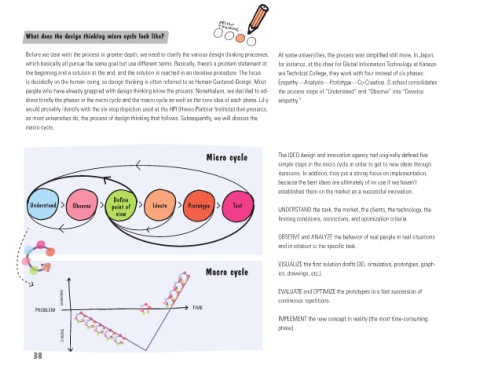
        Before we deal with the process in greater depth, we need to clarify the various design thinking processes,   At some universities, the process was simplified still more. In Japan,
        which basically all pursue the same goal but use different terms. Basically, there’s a problem statement at   for instance, at the chair for Global Information Technology at Kanaza-
        the beginning and a solution at the end, and the solution is reached in an iterative procedure. The focus   wa Technical College, they work with four instead of six phases:
        is decidedly on the human being, so design thinking is often referred to as Human-Centered-Design. Most   Empathy—Analysis—Prototype—Co-Creation. D.school consolidates
        people who have already grappled with design thinking know the process. Nonetheless, we decided to ad-  the process steps of “Understand” and “Observe” into “Develop
        dress briefly the phases in the micro cycle and the macro cycle as well as the core idea of each phase. Lilly   empathy.”
        would probably identify with the six-step depiction used at the HPI (Hasso Plattner Institute) that presents,
        as most universities do, the process of design thinking that follows. Subsequently, we will discuss the
        macro cycle.


                                                            Micro cycle          The IDEO design and innovation agency had originally defined five
                                                                                 simple steps in the micro cycle in order to get to new ideas through
                                                                                 iterations. In addition, they put a strong focus on implementation,
                                                                                 because the best ideas are ultimately of no use if we haven’t
                                                                                 established them on the market as a successful innovation:
                                 Define
          Understand  Observe    point of    Ideate    Prototype    Test
                                  view                                           UNDERSTAND the task, the market, the clients, the technology, the
                                                                                 limiting conditions, restrictions, and optimization criteria.


                                                                                 OBSERVE and ANALYZE the behavior of real people in real situations
                                                                                 and in relation to the specific task.

                                                                                 VISUALIZE the first solution drafts (3D, simulation, prototypes, graph-
                                                            Macro cycle          ics, drawings, etc.).


                   CONVERGE                                                      EVALUATE and OPTIMIZE the prototypes in a fast succession of
                                                                                 continuous repetitions.
           PROBLEM                                      TIME
                                                                                 IMPLEMENT the new concept in reality (the most time-consuming
                                                                                 phase).
                   DIVERGE

           38

