


Page 41 - The Design Thinking Playbook
P. 41
EXPERT TIP

                     The design thinking
                     micro cycle


        DESCRIPTION OF THE INDIVIDUAL PHASES OF THE MICRO CYCLE


                                  Define
          Understand  Observe    point of    Ideate    Prototype    Test
                                  view


        UNDERSTAND:
        This phase was already touched upon in Chapter 1.1. Our starting point was not a goal to be achieved but   Alongside the problem statement, it is important to understand the
        a persona that has needs or is facing the challenge of having to solve a problem. Once the problem has   overall context. Answering the six WH questions (who, why, what,
        been recognized, the problem statement must be defined at the right level of comfort. With two types of   when, where, how) yields fundamental insights:
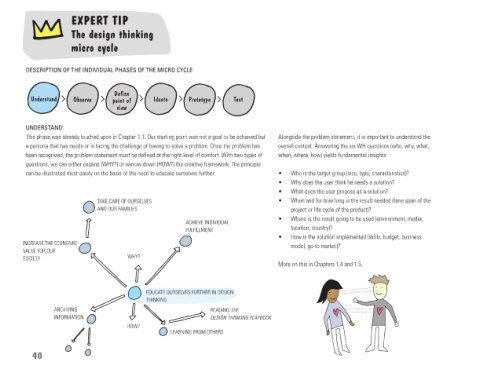
        questions, we can either expand (WHY?) or narrow down (HOW?) the creative framework. The principle
        can be illustrated most easily on the basis of the need to educate ourselves further:  •   Who is the target group (size, type, characteristics)?
                                                                                 •   Why does the user think he needs a solution?
                                                                                 •   What does the user propose as a solution?
                             TAKE CARE OF OURSELVES                              •   When and for how long is the result needed (time span of the
                             AND OUR FAMILIES                                       project or life cycle of the product)?
                                                                                 •   Where is the result going to be used (environment, media,
                                                      ACHIEVE INDIVIDUAL
                                                      FULFILLMENT                   location, country)?
                                                                                 •   How is the solution implemented (skills, budget, business
        INCREASE THE ECONOMIC                                                       model, go-to market)?
        VALUE FOR OUR
        SOCIETY                      WHY?
                                                                                 More on this in Chapters 1.4 and 1.5.


                                           EDUCATE OURSELVES FURTHER IN DESIGN
                                           THINKING
                ARCHIVING                                    READING THE
                INFORMATION                                  DESIGN THINKING PLAYBOOK
                                     HOW?
                                                  LEARNING FROM OTHERS

          40

