


Page 15 - JPGS Newsletter, Issue no. 13, 2021-22
P. 15
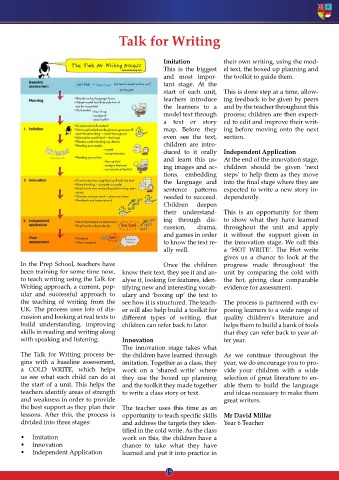
Talk for Writing


        should you need any further ex                    Imitation             their own writing, using the mod-
                                                          This  is the biggest  el text, the boxed up planning and
                                                          and most impor-       the toolkit to guide them.
                                                          tant stage.  At the
                                                          start of each unit,  This is done step at a time, allow-
                                                          teachers  introduce  ing feedback to be given by peers
                                                          the  learners to a  and by the teacher throughout this
                                                          model text through  process; children are then expect-
                                                          a text  or story  ed to edit and improve their writ-
                                                          map.  Before  they  ing before moving onto the next
                                                          even see the text,  section.
                                                          children  are intro-
                                                          duced  to it orally  Independent Application
                                                          and learn this us-    At the end of the innovation stage,
                                                          ing images and ac-    children should  be given ‘next
                                                          tions, embedding  steps’ to help them as they move
                                                          the language and  into the final stage where they are
                                                          sentence  patterns  expected to write a new story in-
                                                          needed to succeed.  dependently.
                                                          Children    deepen
                                                          their understand-     This  is  an  opportunity for  them
                                                          ing through dis-      to  show  what they have  learned
                                                          cussion,    drama,    throughout the unit and apply
                                                          and games in order  it without the support given in
                                                          to know the text re-  the innovation stage. We call this
                                                          ally well.            a ‘HOT WRITE’.  The  Hot write
                                                                                gives us a chance to look at  the
        In the Prep School, teachers have                 Once the children  progress  made  throughout the
        been training for some time now,  know their text, they see it and an-  unit by comparing the cold with
        to teach writing using the Talk for  alyse it, looking for features, iden-  the hot, giving clear comparable
        Writing approach, a current, pop-   tifying new and interesting vocab-  evidence for assessment.
        ular and successful  approach to  ulary and ‘boxing up’ the text to
        the teaching of writing from the  see how it is structured. The teach-  The process is partnered with ex-
        UK. The process uses lots of dis-   er will also help build a toolkit for  posing learners to a wide range of
        cussion and looking at real texts to  different  types  of  writing,  that  quality  children’s literature and
        build understanding, improving  children can refer back to later.       helps them to build a bank of tools
        skills in reading and writing along                                     that they can refer back to year af-
        with speaking and listening.        Innovation                          ter year.
                                            The  innovation stage takes what
        The Talk for Writing process  be-   the children have learned through  As we continue throughout  the
        gins with a baseline assessment,  imitation. Together as a class, they  year, we do encourage you to pro-
        a COLD WRITE, which helps  work on a ‘shared write’ where  vide  your  children  with a wide
        us see what each child can do at  they use the boxed up planning  selection of great literature to en-
        the start of a unit. This helps the  and the toolkit they made together  able them  to  build the language
        teachers identify areas of strength  to write a class story or text.    and ideas necessary to make them
        and weakness in order to provide                                        great writers.
        the best support as they plan their  The teacher uses this time as an
        lessons. After this, the process  is  opportunity to teach specific skills  Mr David Millar
        divided into three stages:          and address the targets they iden-  Year 6 Teacher
                                            tified in the cold write. As the class
        •   Imitation                       work on this, the children have a
        •   Innovation                      chance  to take what they have
        •   Independent Application         learned and put it into practice in


                                                           15
                                                            1 1 1 1
                                                           15
                                                           15
                                                           15

