


Page 1204 - How to Make Money in Stocks Trilogy
P. 1204
Don’t Invest Blindly: Use Charts to See the Best Time to Buy and Sell 187


                               Double Bottom


           Second Most Common Pattern
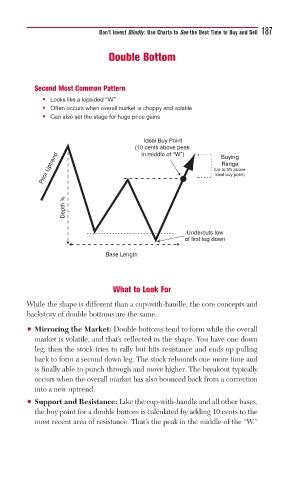
             • Looks like a lopsided “W”
             • Often occurs when overall market is choppy and volatile
             • Can also set the stage for huge price gains


                                         Ideal Buy Point
                                       (10 cents above peak    Buying
             Prior Uptrend                                   (Up to 5% above
                                         in middle of “W”)
                                                               Range
                                                             ideal buy point)


                   Depth %


                                                     Undercuts low
                                                     of first leg down
                               Base Length


                                 What to Look For

         While the shape is different than a cup-with-handle, the core concepts and
         backstory of double bottoms are the same.

         • Mirroring the Market: Double bottoms tend to form while the overall
           market is volatile, and that’s reflected in the shape. You have one down
           leg, then the stock tries to rally but hits resistance and ends up pulling
           back to form a second down leg. The stock rebounds one more time and
           is finally able to punch through and move higher. The breakout typically
           occurs when the overall market has also bounced back from a correction
           into a new uptrend.
         • Support and Resistance: Like the cup-with-handle and all other bases,
           the buy point for a double bottom is calculated by adding 10 cents to the
           most recent area of resistance. That’s the peak in the middle of the “W.”

