


Page 1209 - How to Make Money in Stocks Trilogy
P. 1209
192  HOW TO MAKE MONEY IN STOCKS—GETTING STARTED


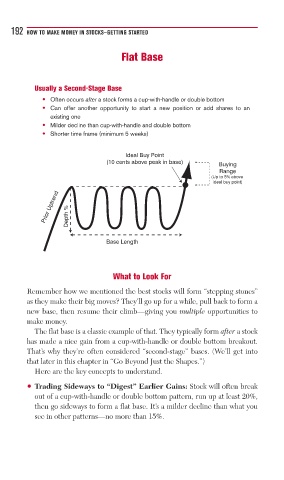
                                   Flat Base


           Usually a Second-Stage Base
             • Often occurs after a stock forms a cup-with-handle or double bottom
             • Can offer another opportunity to start a new position or add shares to an
               existing one
             • Milder decline than cup-with-handle and double bottom
             • Shorter time frame (minimum 5 weeks)


                                    Ideal Buy Point
                               (10 cents above peak in base)
                                                              Buying
                                                              Range
                                                            (Up to 5% above
                                                             ideal buy point)
              Prior Uptrend  Depth %


                               Base Length


                                 What to Look For
         Remember how we mentioned the best stocks will form “stepping stones”
         as they make their big moves? They’ll go up for a while, pull back to form a
         new base, then resume their climb—giving you multiple opportunities to
         make money.
           The flat base is a classic example of that. They typically form after a stock
         has made a nice gain from a cup-with-handle or double bottom breakout.
         That’s why they’re often considered “second-stage” bases. (We’ll get into
         that later in this chapter in “Go Beyond Just the Shapes.”)
           Here are the key concepts to understand.

         • Trading Sideways to “Digest” Earlier Gains: Stock will often break
           out of a cup-with-handle or double bottom pattern, run up at least 20%,
           then go sideways to form a flat base. It’s a milder decline than what you
           see in other patterns—no more than 15%.

