


Page 1213 - How to Make Money in Stocks Trilogy
P. 1213
196  HOW TO MAKE MONEY IN STOCKS—GETTING STARTED


                  More Second Chances with the “Base-on-Base”

         Sometimes a stock will break out from a cup-with-handle or double bottom
         but fail to make the typical 20%–25% gain before starting to form a new
         pattern.
           When that happens, we call it a “base-on-base” formation—and it can
         lead to some powerful moves.


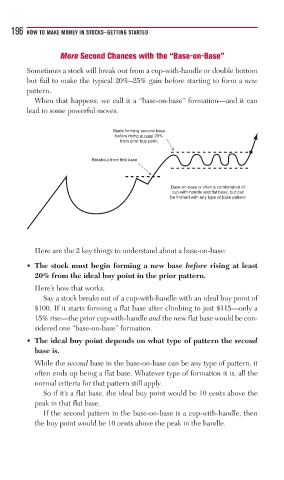
                                 Starts forming second base
                                 before rising at least 20%
                                   from prior buy point

                           Breakout from first base


                                                 Base-on-base is often a combination of
                                                 cup-with-handle and flat base, but can
                                                 be formed with any type of base pattern


           Here are the 2 key things to understand about a base-on-base:

         • The stock must begin forming a new base before rising at least
           20% from the ideal buy point in the prior pattern.
           Here’s how that works.
             Say a stock breaks out of a cup-with-handle with an ideal buy point of
           $100. If it starts forming a flat base after climbing to just $115—only a
           15% rise—the prior cup-with-handle and the new flat base would be con-
           sidered one “base-on-base” formation.
         • The ideal buy point depends on what type of pattern the second
           base is.
           While the second base in the base-on-base can be any type of pattern, it
           often ends up being a flat base. Whatever type of formation it is, all the
           normal criteria for that pattern still apply.
             So if it’s a flat base, the ideal buy point would be 10 cents above the
           peak in that flat base.
             If the second pattern in the base-on-base is a cup-with-handle, then
           the buy point would be 10 cents above the peak in the handle.

