


Page 201 - Learn To Program With Scratch
P. 201
These markers indicate the ball’s
                                                                        position at times 0.5, 1.0, 1.5,
                                                                        2.0, and 2.5 seconds.


                          Figure 7-31: Output of the free-fall simulation

                          Projectile Motion Simulator

              Projectile .sb2  Consider a ball fired at some initial velocity (v ) from a cannon that points
                                                                  0
                          at an angle q from the horizontal. You can analyze the ball’s trajectory by
                          resolving the velocity vector (v ) into its horizontal and vertical components
                                                    0
                          at different times. The horizontal component remains constant, but the
                          vertical component is affected by gravity. When the motions corresponding
                          to these two components are combined, the resulting path is a parabola.
                          Let’s examine the equations that govern projectile motion (neglecting air
                          resistance).
                             The origin of our coordinate system is the point at which the ball begins
                          its flight, so the ball’s x-coordinate at any time, t, is given by x(t) = v t,
                                                                                     0x
                                                               2
                          and the y-coordinate is y(t) = v t − (0.5)gt , where v  = v  cos q is the
                                                     0y
                                                                        0x
                                                                             0
                                                                                          2
                          x- component of v ; v  = v  sin q is the y-component of v ; and g = 9.8 m/s
                                                0
                                                                          0
                                            0y
                                         0
                          is the gravitational acceleration. Using these equations, we can calculate
                          the total flight time, the maximum height, and the horizontal range of the
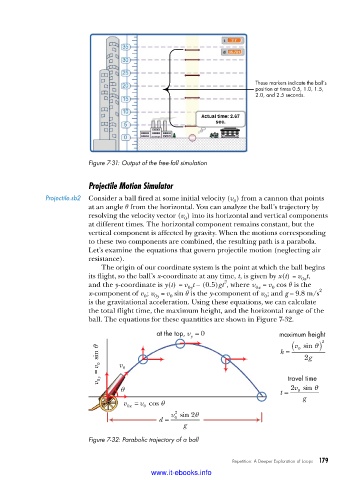
                          ball. The equations for these quantities are shown in Figure 7-32.
                                             at the top, v = 0                 maximum height
                                                      y
                                                                                   v (
                                                                                          2
                            v 0  sin θ  v                                      h =    sin θ ) 0
                                                                                      2
                                                                                       g
                            =      0
                             y                                                   travel time
                            v 0
                                  θ                                            t =  v 2  sin θ
                                                                                    0
                                   v 0 x  = v  cos θ                                 g
                                         0
                                                  2
                                                v  sin 2θ
                                             d =  0
                                                    g
                          Figure 7-32: Parabolic trajectory of a ball
                                                                  Repetition: A Deeper Exploration of Loops   179
                                           www.it-ebooks.info

