


Page 199 - Learn To Program With Scratch
P. 199
Free-Fall Simulation

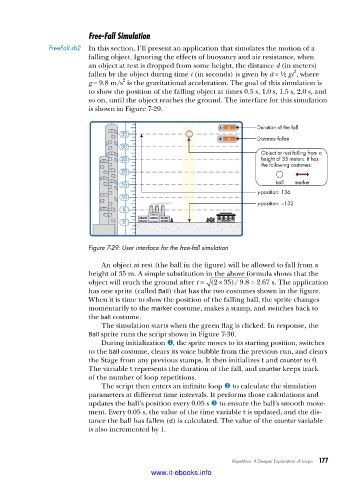
               FreeFall .sb2  In this section, I’ll present an application that simulates the motion of a
                          falling object. Ignoring the effects of buoyancy and air resistance, when
                          an object at rest is dropped from some height, the distance d (in meters)
                                                                                   2
                          fallen by the object during time t (in seconds) is given by d = ½ gt , where
                                   2
                          g = 9.8 m/s  is the gravitational acceleration. The goal of this simulation is
                          to show the position of the falling object at times 0.5 s, 1.0 s, 1.5 s, 2.0 s, and
                          so on, until the object reaches the ground. The interface for this simulation
                          is shown in Figure 7-29.


                                                                        Duration of the fall
                                                                        Distance fallen
                                                                          Object at rest falling from a
                                                                          height of 35 meters. It has
                                                                          the following costumes:

                                                                              ball  marker
                                                                        y-position: 136
                                                                        y-position: −132


                          Figure 7-29: User interface for the free-fall simulation

                             An object at rest (the ball in the figure) will be allowed to fall from a
                          height of 35 m. A simple substitution in the above formula shows that the
                          object will reach the ground after t = (2 × 35)/ 9.8 = 2.67 s. The application
                          has one sprite (called Ball) that has the two costumes shown in the figure.
                          When it is time to show the position of the falling ball, the sprite changes
                          momentarily to the marker costume, makes a stamp, and switches back to
                          the ball costume.
                             The simulation starts when the green flag is clicked. In response, the
                          Ball sprite runs the script shown in Figure 7-30.
                             During initialization u, the sprite moves to its starting position, switches
                          to the ball costume, clears its voice bubble from the previous run, and clears
                          the Stage from any previous stamps. It then initializes t and counter to 0.
                          The variable t represents the duration of the fall, and counter keeps track
                          of the number of loop repetitions.
                             The script then enters an infinite loop v to calculate the simulation
                          parameters at different time intervals. It performs those calculations and
                          updates the ball’s position every 0.05 s w to ensure the ball’s smooth move-
                          ment. Every 0.05 s, the value of the time variable t is updated, and the dis-
                          tance the ball has fallen (d) is calculated. The value of the counter variable
                          is also incremented by 1.


                                                                  Repetition: A Deeper Exploration of Loops   177

                                           www.it-ebooks.info

