


Page 43 - Learn To Program With Scratch
P. 43
Some function blocks have a checkbox next to them. If you check
                          the box, a monitor appears on the Stage to display the current value of the
                          reporter. Select a sprite and check the box on the x position block (in the
                          Motion palette). Then drag the sprite around the Stage and watch that mon-
                          itor. It should change as you move the sprite back and forth.


               arithmetic operators and functions
                          Now, let’s take a quick look at the arithmetic operators and functions sup-
                          ported in Scratch. If you’ve lost your calculator, then your worries are over!
                          You could make your own calculator in Scratch with the blocks from the
                          Operators palette, which you’ll explore in this section.

                          Arithmetic Operators
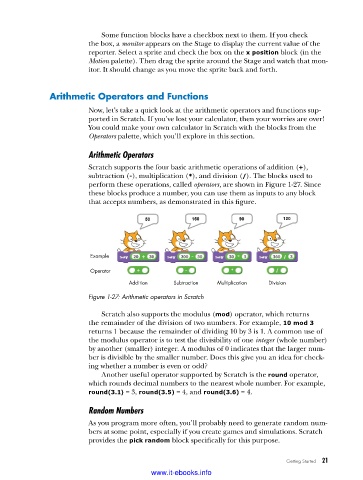
                          Scratch supports the four basic arithmetic operations of addition (+),
                          subtraction (-), multiplication (*), and division (/). The blocks used to
                          perform these operations, called operators, are shown in Figure 1-27. Since
                          these blocks produce a number, you can use them as inputs to any block
                          that accepts numbers, as demonstrated in this figure.


                          Example
                          Operator
                                     Addition    Subtraction  Multiplication  Division

                          Figure 1-27: Arithmetic operators in Scratch

                             Scratch also supports the modulus (mod) operator, which returns
                          the remainder of the division of two numbers. For example, 10 mod 3
                          returns 1 because the remainder of dividing 10 by 3 is 1. A common use of
                          the modulus operator is to test the divisibility of one integer (whole number)
                          by another (smaller) integer. A modulus of 0 indicates that the larger num-
                          ber is divisible by the smaller number. Does this give you an idea for check-
                          ing whether a number is even or odd?
                             Another useful operator supported by Scratch is the round operator,
                          which rounds decimal numbers to the nearest whole number. For example,
                          round(3.1) = 3, round(3.5) = 4, and round(3.6) = 4.

                          Random Numbers

                          As you program more often, you’ll probably need to generate random num-
                          bers at some point, especially if you create games and simulations. Scratch
                          provides the pick random block specifically for this purpose.

                                                                                 Getting Started   21

                                           www.it-ebooks.info

