


Page 133 - T-I JOURNAL19 4
P. 133
INVESTING IN ACADEMIC TECHNOLOGY INNOVATION                    781


                   University of New Hampshire ..........................................2016 .......................... New Hampshire
                   New Mexico State University ............................................2016 .......................... New Mexico
                   Rensselaer Polytechnique Institute ..................................2016 .......................... New York
                   Arizona State University ....................................................2016 .......................... Arizona
                   Jackson State University.....................................................2016 .......................... MIssissippi
                   University of California, Irvine ........................................2017 .......................... California
                   City University New York ..................................................2017 .......................... New York
                   Brandeis University ............................................................2017 .......................... Massachusetts
                   New York University ..........................................................2017 .......................... New York
                   George Washington University.........................................2017 .......................... DC
                   Cornell University ..............................................................2017 .......................... New York
                   Johns Hopkins University .................................................2017 .......................... Maryland
                   University of Alabama Birmingham ................................2017 .......................... Alabama
                   University of Georgia .........................................................2017 .......................... Georgia
                   University of Massachusetts Lowell .................................2017 .......................... Massachusetts
                   University of California, Santa Cruz ................................2017 .......................... California
                   University of Virginia.........................................................2017 .......................... Virginia
                   Mississippi State University ...............................................2017 .......................... Mississippi
                   Texas A&M Main Campus ................................................2017 .......................... Texas
                   California State University Northridge ...........................2017 .......................... California
                   University of California, Merced ......................................2017 .......................... California


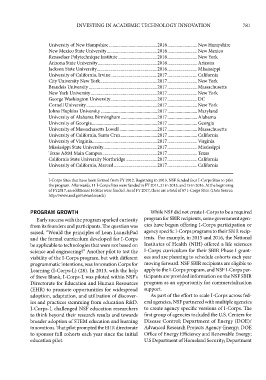
                   I-Corps Sites that have been formed from FY 2012. Beginning in 2013, NSF funded four I-Corps Sites to pilot
                   the program. Afterwards, 11 I-Corps Sites were funded in FY 2014, 21 in 2015, and 15 in 2016. At the beginning
                   of FY2017, an additional 16 Sites were funded. As of FY 2017, there are a total of 67 I-Corps Sites. (Data Source:
                   http://www.msf.gov/awardsearch)


             PROGRAM GROWTH                               While NSF did not create I-Corps to be a required
               Early success with the program sparked curiosity   program for SBIR recipients, some government agen-
             from its founders and participants. The question was   cies have begun offering I-Corps participation or
             raised, “Would the principles of Lean LaunchPad   agency specific I-Corps programs to their SBIR recip-
             and the formal curriculum developed for I-Corps   ients.  For example, in 2015 and 2016, the National
             be applicable to technologies that were not based on   Institutes of Health (NIH) offered a life sciences
             science and engineering?” Another pilot to test the  I-Corps curriculum for their SBIR Phase I grant-
             viability of the I-Corps program, but with different  ees and are planning to schedule cohorts each year
             programmatic intentions, was Innovation Corps for  moving forward. NSF SBIR recipients are eligible to
             Learning (I-Corps-L) (28). In 2013, with the help  apply to the I-Corps program, and NSF I-Corps par-
             of Steve Blank, I-Corps-L was piloted within NSF’s  ticipants are provided information on the NSF SBIR
             Directorate for Education and Human Resources  program as an opportunity for commercialization
             (EHR) to promote opportunities for widespread  support.
             adoption, adaptation, and utilization of discover-    As part of the effort to scale I-Corps across fed-
             ies and practices stemming from education R&D.  eral agencies, NSF partnered with multiple agencies
             I-Corps-L challenged NSF education researchers  to create agency specific versions of I-Corps. The
             to think beyond their research results and towards  first group of agencies included the U.S. Centers for
             broader adoption of STEM education and learning  Disease Control; Department of Energy (DOE)/
             innovations. That pilot prompted the EHR directorate  Advanced Research Projects Agency-Energy; DOE
             to sponsor full cohorts each year since the initial  Office of Energy Efficiency and Renewable Energy;
             education pilot.                           U.S Department of Homeland Security; Department

