


Page 134 - T-I JOURNAL19 4
P. 134
782                        NNAKWE, COOCH & HUANG-SAAD                                                                        INVESTING IN ACADEMIC TECHNOLOGY INNOVATION                    783


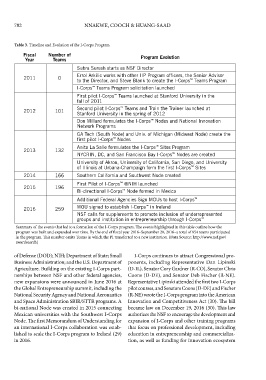
       Table 3. Timeline and Evolution of the I-Corps Program
          Fiscal   Number of
           Year      Teams                            Program Evolution
                              Subra Suresh starts as NSF Director
                              Errol Arkilic works with other IIP Program officers, the Senior Advisor
          2011         0
                              to the Director, and Steve Blank to create the I-Corps  Teams Program
                                                                         ™
                                    ™
                              I-Corps  Teams Program solicitation launched
                              First pilot I-Corps  Teams launched at Stanford University in the
                                            ™
                              fall of 2011
                                               ™
          2012        101     Second pilot I-Corps  Teams and Train the Trainer launched at
                              Stanford University in the spring of 2012
                                                          ™
                              Don Millard formulates the I-Corps  Nodes and National Innovation
                              Network Programs
                              GA Tech (South Node) and Univ. of Michigan (Midwest Node) create the
                              first pilot I-Corps  Nodes
                                            ™
                              Anita La Salle formulates the I-Corps  Sites Program
                                                            ™
          2013        132
                              NYCRIN, DC, and San Francisco Bay I-Corps  Nodes are created
                                                                  ™
                              University of Akron, University of California, San Diego, and University
                              of Illinois at Urbana-Champaign form the first I-Corps  Sites
                                                                         ™
          2014        166     Southern California and Southwest Node created
                              First Pilot of I-Corps  @NIH launched
                                              ™
          2015        196
                                               ™
                              Bi-directional I-Corps  Node formed in Mexico
                              Additional Federal Agencies Sign MOUs to host I-Corps ™                               Figure 1. The Geographic distribution of NSF I-Corps Teams award recipients. Geographic map of NSF I-Corps Teams, Nodes
                                                        ™
          2016        259     MOU signed to establish I-Corps  in Ireland                                           (squares), and Sites (circles) awards from October 2011 to March 2017. The distribution includes I-Corps-L teams and PIs
                                                                                                                    that have participated more than once to explore the commercial potential of different technologies (Source: https://www.
                              NSF calls for supplements to promote inclusion of underrepresented                    nsf.gov/awardsearch/ advancedSearch.jsp).
                              groups and institution in entrepreneurship through I-Corps
                                                                             ™
       Summary of the events that led to a formation of the I-Corps program. The events highlighted in this table outline how the   development at locations that the NSF designates as  Minorities, and Persons with Disabilities in Science
       program was built and expanded over time. By the end of fiscal year 2016–September 20, 2016–a total of 854 teams participated
       in the program. This number omits Teams in which the PI transferred to a new institution. (Data Source: http://www.nsf.gov/  regional and national infrastructure for science and  and Engineering: 2017, a special report from NSF,
       awardsearch)                                                                                              engineering entrepreneurship. It also directs the NSF  scientists and engineers from under-represented pop-
                                                                                                                 to create partnerships with other federal agencies that  ulations remain behind in educational attainment
      of Defense (DOD); NIH; Department of State; Small    I-Corps continues to attract Congressional pro-       enable them to send their grantees to NSF I-Corps  and the science and engineering workforce (27,31).
      Business Administration; and the U.S. Department of  ponents, including Representative Dan Lipinski        program cohorts or to help them create their own  Broadening participation of under-represented pop-
      Agriculture. Building on the existing I-Corps part-  (D-IL), Senator Cory Gardner (R-CO), Senator Chris    versions of the I-Corps program.           ulations is a well-articulated priority at the NSF (32).
      nerships between NSF and other federal agencies,  Coons (D-DE), and Senator Deb Fischer (R-NE).              Finally, the law authorized the NSF to engage   NSF defines broadening participation in terms of
      new expansions were announced in June 2016 at  Representative Lipinski attended the first two I-Corps      in partnerships with state and local governments,  individuals from under-represented groups as well as
      the Global Entrepreneurship summit, including the  pilot courses, and Senators Coons (D-DE) and Fischer    economic development organizations, and nonprofit  institutions and geographic areas that do not partic-
      National Security Agency and National Aeronautics  (R-NE) wrote the I-Corps program into the American      organizations to provide access to the I-Corps pro-  ipate in NSF research programs at rates comparable
      and Space Administration SBIR/STTR programs. A  Innovation and Competitiveness Act (30). The bill          gram to support entrepreneurship education and  to others. Addressing the challenges of broadening
      bi-national Node was created in 2015 connecting  became law on December 19, 2016 (30). This law            training for researchers, students, and institutions.  participation in STEM is a priority within the I-Corps
      Mexican universities with the Southwest I-Corps  authorizes the NSF to encourage the development and                                                  program. In an effort to address this challenge and
      Node. The first Memorandum of Understanding for  expansion of I-Corps and other training programs          CHALLENGES AND OPPORTUNITIES               promote the inclusion of entrepreneurial founders
      an international I-Corps collaboration was estab-  that focus on professional development, including         Although a great deal has been accomplished   from under-represented populations in STEM entre-
      lished to scale the I-Corps program to Ireland (29)  education in entrepreneurship and commercializa-      with I-Corps, a number of challenges remain as the  preneurship, NSF mobilized a call for supplements to
      in 2016.                                    tion, as well as funding for innovation ecosystem              program continues to scale. According to Women,  promote inclusion in entrepreneurship from I-Corps

