


Page 106 - MARSIUM'21 COMP OF PAPER
P. 106
83                                         Nadia Safian (2021)

            conclusions can be drawn. The target population should be defined according to factors, sample units, scale and time  (Malhotra and Birks,
            2007).
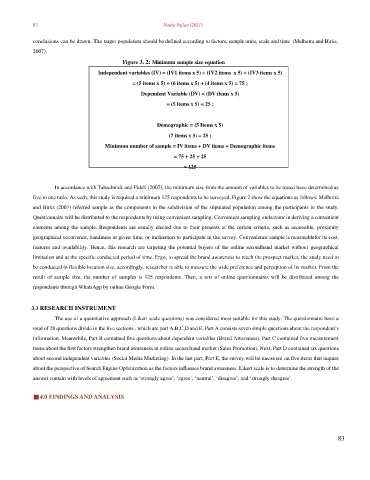
                                          Figure 3. 2: Minimum sample size equation

                                 Independent variables (IV) = (IV1 items x 5) + (IV2 items  x 5) + (IV3 items x 5)
                                             = (5 items x 5) + (6 items x 5) + (4 items x 5) = 75 ;

                                                Dependent Variable (DV) = (DV items x 5)
                                                        = (5 items x 5) = 25 ;


                                                     Demographic = (5 Items x 5)
                                                         (7 items x 5) = 25 ;

                                    Minimum number of sample = IV items + DV items + Demographic items
                                                           = 75 + 25 + 25
                                                              = 125


                   In accordance with Tabachnick and Fidell (2007), the minimum size from the amount of variables to be tested have determined as
            five to one ratio. As such, this study is required a minimum 125 respondents to be surveyed. Figure 2 show the equations as follows: Malhotra
            and Birks (2007) referred sample as the components in the subdivision of the stipulated population among the participants in the study.
            Questionnaire will be distributed to the respondents by using convenient sampling. Convenient sampling endeavour in deriving a convenient
            elements among the sample.  Respondents are usually elected due to their presents at  the certain criteria,  such as accessible,  proximity
            geographical occurrence, handiness at given time, or inclination to participate in the survey. Convenience sample is reasonable for its cost,
            features and availability. Hence, this research are targeting the potential  buyers of the online secondhand market  without  geographical
            limitation and at the specific conducted period of time. Ergo, to spread the brand awareness to reach the prospect market, the study need to
            be conducted in flexible location size, accordingly, researcher is able to measure the wide preference and perception of its market. From the
            result  of  sample  size,  the  number  of  samples  is  125  respondents.  Then,  a  sets  of  online  questionnaires  will  be  distributed  among  the
            respondents through WhatsApp by online Google Form.


           3.3 RESEARCH INSTRUMENT
                   The use of a quantitative approach (Likert scale questions) was considered most suitable for this study. The questionnaire have a
            total of 28 questions divide in the five sections , which are part A,B,C,D and E. Part A consists seven simple questions about the respondent’s
            information. Meanwhile, Part B contained five questions about dependent variables (Brand Awareness). Part C contained five measurement
            items about the first factors strengthen brand awareness in online secondhand market (Sales Promotion). Next, Part D contained six questions
            about second independent variables (Social Media Marketing). In the last part, Part E, the survey will be measured on five items that inquire
            about the perspective of Search Engine Optimization as the factors influence brand awareness. Likert scale is to determine the strength of the
            answer contain with levels of agreement such as ‘strongly agree’, ‘agree’, ‘neutral’, ‘disagree’, and ‘strongly disagree’.


            ⬛ 4.0 FINDINGS AND ANALYSIS


                                                                                                                 83

