


Page 108 - MARSIUM'21 COMP OF PAPER
P. 108
85                                         Nadia Safian (2021)

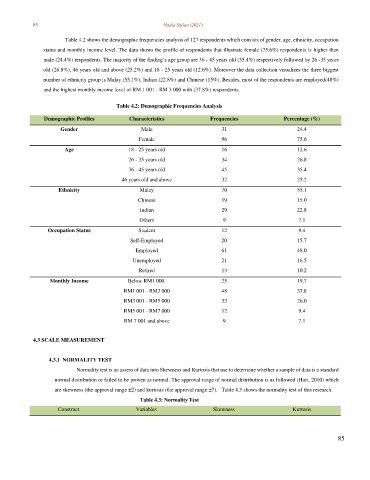
                       Table 4.2 shows the demographic frequencies analysis of 127 respondents which consists of gender, age, ethnicity, occupation
               status and monthly income level. The data shows the profile of respondents that illustrate female (75.6%) respondents is higher than
               male (24.4%) respondents. The majority of the finding’s age group are 36 - 45 years old (35.4%) respectively followed by 26 -35 years
               old (26.8%), 46 years old and above (25.2%) and 18 - 25 years old (12.6%). Moreover the data collection visualizes the three biggest
               number of ethnicity group is Malay (55.1%), Indian (22.8%) and Chinese (15%). Besides, most of the respondents are employed(48%)
               and the highest monthly income level of RM 1 001 - RM 3 000 with (37.8%) respondents.

                                        Table 4.2: Demographic Frequencies Analysis

                Demographic Profiles        Characteristics            Frequencies             Percentage (%)
                     Gender                     Male                      31                       24.4
                                               Female                     96                       75.6
                      Age                   18 - 25 years old             16                       12.6
                                            26 - 35 years old             34                       26.8
                                            36 - 45 years old             45                       35.4
                                         46 years old and above           32                       25.2
                    Ethnicity                  Malay                      70                       55.1
                                               Chinese                    19                       15.0
                                               Indian                     29                       22.8
                                               Others                      9                        7.1

                 Occupation Status             Student                    12                        9.4
                                            Self-Employed                 20                       15.7
                                              Employed                    61                       48.0
                                             Unemployed                   21                       16.5
                                               Retired                    13                       10.2
                  Monthly Income           Below RM1 000                  25                       19.7
                                          RM1 001 - RM3 000               48                       37.8
                                          RM3 001 - RM5 000               33                       26.0
                                          RM5 001 - RM7 000               12                        9.4
                                          RM 7 001 and above               9                        7.1


            4.3 SCALE MEASUREMENT


                 4.3.1  NORMALITY TEST
                          Normality test is an assess of data into Skewness and Kurtosis that use to determine whether a sample of data is a standard
                   normal distribution or failed to be proven as normal. The approval range of normal distribution is as followed (Hair, 2010) which
                   are skewness (the approval range ±2) and kurtosis (the approval range ±7).   Table 4.3 shows the normality test of this research.
                                               Table 4.3: Normality Test
                    Construct                 Variables                 Skewness                  Kurtosis


                                                                                                                 85

