


Page 204 - MARSIUM'21 COMP OF PAPER
P. 204
182                                        Fatin Nazurah (2022)

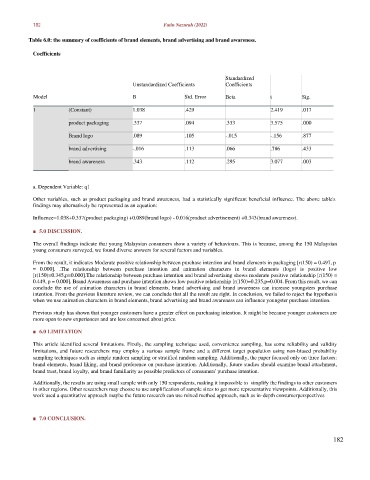
           Table 6.0: the summary of coefficients of brand elements, brand advertising and brand awareness.

            Coefficients


                                                                            Standardized
                                             Unstandardized Coefficients    Coefficients

            Model                            B                Std. Error    Beta           t         Sig.

            1           (Constant)           1.038            .429                         2.419     .017

                        product packaging    .337             .094          .333           3.575     .000
                        Brand logo           .089             .105          -.015          -.156     .877

                        brand advertising    -.016            .113          .066           .786      .433

                        brand awareness      .343             .112          .295           3.077     .003


            a. Dependent Variable: q1

            Other variables, such as product packaging and brand awareness, had a statistically significant beneficial influence. The above table's
            findings may alternatively be represented as an equation:

            Influence=1.038+0.337(product packaging) +0.089(brand logo) - 0.016(product advertisement) +0.343(brand awareness).

            ■  5.0 DISCUSSION.

            The overall findings indicate that young Malaysian consumers show a variety of behaviours. This is because, among the 150 Malaysian
            young consumers surveyed, we found diverse answers for several factors and variables.

            From the result, it indicates Moderate positive relationship between purchase intention and brand elements in packaging [r(150) = 0.497, p
            =  0.000].  .The  relationship  between  purchase  intention  and  animation  characters  in  brand  elements  (logo)  is  positive  low
            [r(150)=0.345,p=0.000].The relationship between purchase intention and brand advertising shows moderate positive relationship [r(150) =
            0.449, p = 0.000]. Brand Awareness and purchase intention shows low positive relationship [r(150)=0.235,p=0.004. From this result, we can
            conclude  the  use  of  animation  characters  in brand  elements,  brand  advertising  and brand  awareness  can  increase  youngsters  purchase
            intention. From the previous literature review, we can conclude that all the result are right. In conclusion, we failed to reject the hypothesis
            when we use animation characters in brand elements, brand advertising and brand awareness can influence youngster purchase intention.

            Previous study has shown that younger customers have a greater effect on purchasing intention. It might be because younger customers are
            more open to new experiences and are less concerned about price.

            ■  6.0 LIMITATION

            This article identified several limitations. Firstly, the sampling  technique used, convenience sampling, has some reliability and validity
            limitations,  and  future  researchers  may  employ  a various  sample  frame  and  a  different  target  population using non-biased probability
            sampling techniques such as simple random sampling or stratified random sampling. Additionally, the paper focused only on three factors:
            brand elements, brand liking, and brand preference on purchase intention. Additionally, future studies should examine brand attachment,
            brand trust, brand loyalty, and brand familiarity as possible predictors of consumers' purchase intention.
            Additionally, the results are using small sample with only 150 respondents, making it impossible to  simplify the findings to other customers
            in other regions. Other researchers may choose to use amplification of sample sizes to get more representative viewpoints. Additionally, this
            work used a quantitative approach maybe the future research can use mixed method approach, such as in-depth consumer perspectives


            ■  7.0 CONCLUSION.


                                                                                                               182

