


Page 286 - MARSIUM'21 COMP OF PAPER
P. 286
Number of view(s)                 690174            100.00
                                                       Number of like(s)                   2242              2.86
                     Twitter              507          Number of comments(s)                304              1.13
                                                       Number of retweet(s)                1871            100.00

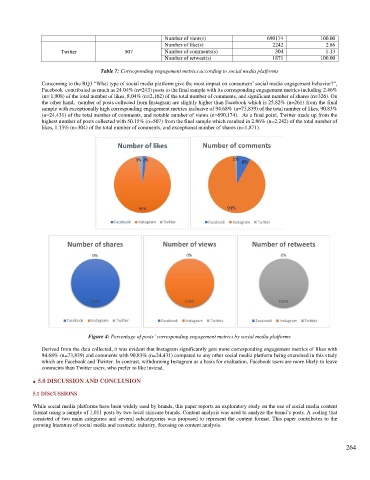
                                  Table 7: Corresponding engagement metrics according to social media platforms

               Concerning to the RQ3 “What type of social media platform give the most impact on consumers’ social media engagement behavior?”,
               Facebook  contributed as much as 24.04% (n=243) posts to the final sample with its corresponding engagement metrics including 2.46%
               (n= 1,908) of the total number of likes, 8.04% (n=2,162) of the total number of comments, and significant number of shares (n=326). On
               the other hand,  number of posts collected from Instagram are slightly higher than Facebook which is 25.82% (n=261) from the final
               sample with exceptionally high corresponding engagement metrics inclusive of 94.68% (n=73,839) of the total number of likes, 90.83%
               (n=24,431) of the total number of comments, and notable number of views (n=690,174).  As a final point, Twitter made up from the
               highest number of posts collected with 50.15% (n=507) from the final sample which resulted in 2.86% (n=2,242) of the total number of
               likes, 1.13% (n=304) of the total number of comments, and exceptional number of shares (n=1,871).


                              Figure 4: Percentage of posts’ corresponding engagement metrics by social media platforms

               Derived from the data collected, it was evident that Instagram significantly gets more corresponding engagement metrics of likes with
               94.68% (n=73,839) and comments with 90.83% (n=24,431) compared to any other social media platform being examined in this study
               which are Facebook and Twitter. In contrast, withdrawing Instagram as a basis for evaluation, Facebook users are more likely to leave
               comments than Twitter users, who prefer to like instead.

            ■  5.0 DISCUSSION AND CONCLUSION

            5.1 DISCUSSIONS

            While social media platforms have been widely used by brands, this paper reports an exploratory study on the use of social media content
            format using a sample of 1,011 posts by two local skincare brands. Content analysis was used to analyze the brand’s posts. A coding that
            consisted of two main categories and several subcategories was proposed to represent the content format. This paper contributes to the
            growing literature of social media and cosmetic industry, focusing on content analysis.


                                                                                                                    264

