


Page 447 - MARSIUM'21 COMP OF PAPER
P. 447
426                                  Qayum & Mazilah (2021)

                Moreover, since retailers often confront a conflict between the company’s expectations and the customers’ requirements, they must
            manage the competing connections that exist among companies, direct service providers (employees), and customers (Weatherly & Tansik,
            1992). In many ways, the right of control that businesses give to their employees is linked to the right of control that employees grant to
            consumers (Pei et al., 2020). As a result of meeting the staff members' desire for control, the staff also give consumers the right to exercise
            control. When employees do not have a control over their work, they will resort to administrative means to acquire it. As a result, the
            customers' right to control is diminished, if not completely ignored, resulting in lower customer satisfaction (Ku, 2019). Therefore, the
            researcher proposes the following:
                    H2: Customer experience with staff service has a significant positive influence towards customer satisfaction.

                               2.2.3 Customer Experience with Shopping Procedure and Customer Satisfaction

                 The purchasing process must be as competent and efficient as possible to achieve the maximum client pleasure, and the effectiveness
            of a store's operation affects the competitiveness of the business in the marketplace (Artusi et al., 2020). Shopping operations strategy and
            management efficiency have an impact on both the quality of services provided and the success of a retail establishment. The goal of
            improving the customer experience is to better meet the expectations of the customers. Unsatisfactory efficiency of organizational operations
            when shopping leads to an unpleasant customer experience and high levels of consumer discontent (Chen et al., 2020). As a result, the
            researcher proposes the following:

                     H3: Customer experience with shopping procedures has a significant positive influence towards customer satisfaction.

            2.2.4 Customer Product Experience and Customer Satisfaction

                When it comes to the connection of customer experience and customer satisfaction in shopping, rewards and pleasant emotions excite
            consumers, and may contribute to the overall customer satisfaction (Varki & Lecturer, 1997). Customer satisfaction, product attention, and
            brand dependability may all be improved by providing a positive product experience according to Zarantonello & Schmitt (2010). Learning
            about the link between quality and customer satisfaction has provided some insights into assessing the overall degree of satisfaction with a
            product (Mumtaz et al., 2011).

                In  contrast  to  the  notion  of  an  emotional  relationship,  product  experience,  rather  than  emotional  connection,  is  most  likely  the
            consequence of an emotional connection while emotion is the result of internal stimulation (Šerić et al., 2020). The view that customer
            satisfaction is an expression of emotions that may be either good or negative, and either short- or long-term has been held by all of the
            researchers. The research finds that product experience, instead of basic cognitive activity, is an analytical and convergent mental experience
            at a higher degree in nature than a simple cognitive development. This will culminate in brand assessment, which will serve as an essential
            foundation for brand attitude and repeat purchasing behaviour among consumers. Therefore, the researcher proposes the following:

                  H4: Customer experience with product experience has a significant positive influence towards customer satisfaction.

            2.3 RESEARCH FRAMEWORK MODEL

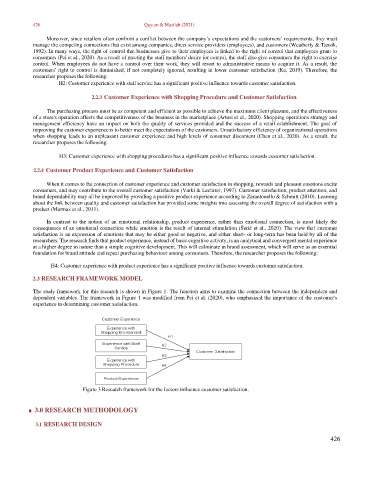
            The study framework for this research is shown in Figure 1. The function aims to examine the connection between the independent and
            dependent variables. The framework in Figure 1 was modified from Pei et al. (2020), who emphasized the importance of the customer's
            experience in determining customer satisfaction.


                            Figure 3 Research framework for the factors influence customer satisfaction.


           ■  3.0 RESEARCH METHODOLOGY

             3.1 RESEARCH DESIGN

                                                                                                              426

