


Page 492 - MARSIUM'21 COMP OF PAPER
P. 492
Muhammad Amirul Asraf Bin Sungip (2022)


                                  Recruitment              24                    22.2
                                   Executive               14                     13

                             Years of Service in The Present Organization

                                Less than 2 years          15                    13.9

                                   2-5 years               40                     37

                                   5-10 years              41                     38

                                More than 10 years         12                    11.1


                          4.2 Reliability Analysis

                  4.2.1 Pearson Correlation

                         Pearson's correlation coefficient assesses the strength of a two-variable linear connection (Publications et al.,
                  2015). The Pearson Correlation is a statistical method for determining the strength of a relationship between independent
                  and dependent variables. According to Hemphill (2003), A substantial link exists between values over 0.5 and another
                  variable. As seen in table 4.3, all of the variables are more than 0.5, indicating that they are all correlated.


                              4.2.2 Cronbach Alpha

                         Following the Pearson Correlation analysis, the researchers calculated the Cronbach Alpha for each independent
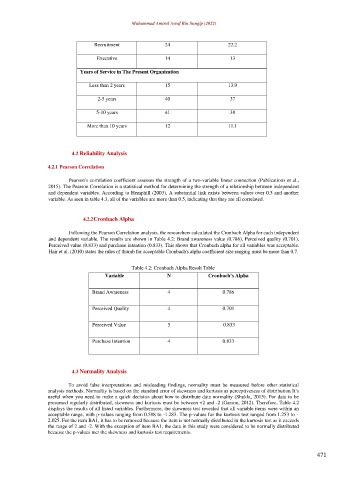
                  and dependent variable. The results are shown in Table 4.2: Brand awareness value (0.786), Perceived quality (0.701),
                  Perceived value (0.833) and purchase intention (0.833). This shows that Cronbach alpha for all variables was acceptable.
                  Hair et al. (2010) states the rules of thumb for acceptable Cronbach's alpha coefficient size ranging must be more than 0.7.

                                               Table 4.2: Cronbach Alpha Result Table

                                      Variable              N             Cronbach’s Alpha

                                 Brand Awareness            4                  0.786


                                 Perceived Quality          4                  0.701

                                 Perceived Value            5                  0.833


                                 Purchase Intention         4                  0.833


                          4.3 Normality Analysis

                         To  avoid  false  interpretations  and  misleading  findings,  normality  must  be  measured  before  other  statistical
                  analysis methods. Normality is based on the standard error of skewness and kurtosis as perceptiveness of distribution It’s
                  useful when you need to make a quick decision about how to distribute data normality (Shukla, 2015). For data to be
                  presumed regularly distributed, skewness and kurtosis must be between +2 and -2 (Garson, 2012). Therefore, Table 4.2
                  displays the results of all listed variables. Furthermore, the skewness test revealed that all variable items were within an
                  acceptable range, with p-values ranging from 0.588 to -1.283. The p-values for the kurtosis test ranged from 1.253 to -
                  2.025. For the item BA1, it has to be removed because the item is not normally distributed in the kurtosis test as it exceeds
                  the range of 2 and -2. With the exception of item BA1, the data in this study were considered to be normally distributed
                  because the p-values met the skewness and kurtosis test requirements.


                                                                                                                471

