


Page 539 - MARSIUM'21 COMP OF PAPER
P. 539
Ng Wai Teng (2021)


                                                  H1
                              BRAND

                                                   H2                                    CONSUMER
                              PRICE                                                     PURCHASING

                                                                                         INTENTION

                                                   H3
                              TREND


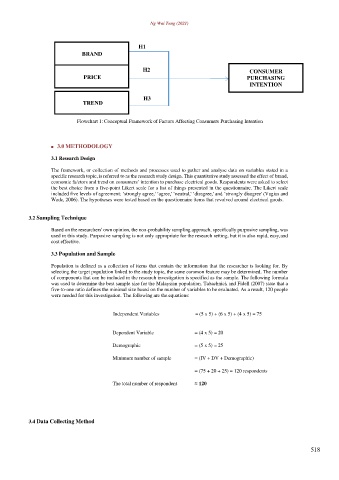
                            Flowchart 1: Conceptual Framework of Factors Affecting Consumers Purchasing Intention


                   ■  3.0 METHODOLOGY

                   3.1 Research Design

                   The framework, or collection of methods and processes used to gather and analyse data on variables stated in a
                   specific research topic, is referred to as the research study design. This quantitative study assessed the effect of brand,
                   economic fa/ctors and trend on consumers’ intention to purchase electrical goods. Respondents were asked to select
                   the best choice from a five-point Likert scale for a list of things presented in the questionnaire. The Likert scale
                   included five levels of agreement: ‘strongly agree,' ‘agree,' ‘neutral,' ‘disagree,' and ‘strongly disagree' (Vagias and
                   Wade, 2006). The hypotheses were tested based on the questionnaire items that revolved around electrical goods.


           3.2 Sampling Technique

                   Based on the researchers' own opinion, the non-probability sampling approach, specifically purposive sampling, was
                   used in this study. Purposive sampling is not only appropriate for the research setting, but it is also rapid, easy, and
                   cost effective.

                   3.3 Population and Sample

                   Population is defined as a collection of items that contain the information that the researcher is looking for. By
                   selecting the target population linked to the study topic, the same common feature may be determined. The number
                   of components that can be included in the research investigation is specified as the sample. The following formula
                   was used to determine the best sample size for the Malaysian population. Tabachnick and Fidell (2007) state that a
                   five-to-one ratio defines the minimal size based on the number of variables to be evaluated. As a result, 120 people
                   were needed for this investigation. The following are the equations:


                                         Independent Variables        = (5 x 5) + (6 x 5) + (4 x 5) = 75


                                         Dependent Variable          = (4 x 5) = 20

                                         Demographic                 = (5 x 5) = 25

                                         Minimum number of sample    = (IV + DV + Demographic)

                                                                     = (75 + 20 + 25) = 120 respondents

                                         The total number of respondent   ≈ 120


           3.4 Data Collecting Method


                                                                                                              518

