


Page 542 - MARSIUM'21 COMP OF PAPER
P. 542
Ng Wai Teng (2021)


                                                                   1. I made purchase to follow up to the latest
                                                                   trend.
                                  Navarro, G. M. (2016). The influence of
                                  blogs in fashion in consumer behavior: an   2. I think I can express my feelings based on my
                                       exploratory approach. Vivat       lifestyles.
                                      Academia, 19(135), 85-109.   3. Other people influence me to follow trend.
                      Trends
                                                                   4. I feel satisfied when I follow the trend.


                   C. Dependent Variable


                                                                   1. I would like to have more information of the
                                                                   business
                                    Singh, R. P., & Banerjee, N. (2018).
                                    Exploring the influence of celebrity   2. I’m likely to make a purchase from the shop
                                 credibility on brand attitude, advertisement
                     Consumer      attitude and purchase intention. Global   3. I’m interested in the brand of the business
                                    Business Review, 19(6), 1622-1639.
                     Purchase
                     Intention

                                McClure, C., & Seock, Y. K. (2020). The role
                                of involvement: Investigating the effect of   4. In the future I’m very likely to purchase from
                                brand's social media pages on consumer   this business
                                purchase intention. Journal of Retailing and
                                Consumer Services, 53, 101975.

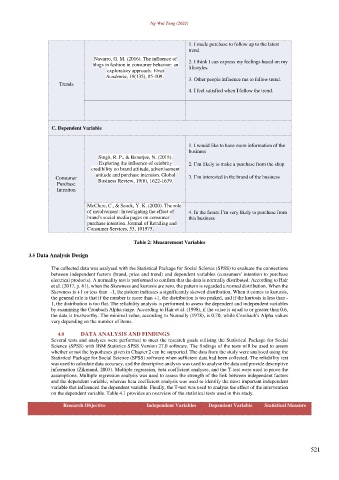
                                                Table 2: Measurement Variables

           3.5 Data Analysis Design

                   The collected data was analysed with the Statistical Package for Social Science (SPSS) to evaluate the connections
                   between independent factors (brand, price and trend) and dependent variables (consumers' intention to purchase
                   electrical products). A normality test is performed to confirm that the data is normally distributed. According to Hair
                   et al. (2017, p. 61), when the Skewness and kurtosis are zero, the pattern is regarded a normal distribution. When the
                   Skewness is +1 or less than  -1, the pattern indicates a significantly skewed distribution. When it comes to kurtosis,
                   the general rule is that if the number is more than +1, the distribution is too peaked, and if the kurtosis is less than -
                   1, the distribution is too flat. The reliability analysis is performed to assess the dependent and independent variables
                   by examining the Cronbach Alpha range. According to Hair et al. (1998), if the value is equal to or greater than 0.6,
                   the data is trustworthy. The minimal value, according to Nunnally (1978), is 0.70, while Cronbach's Alpha values
                   vary depending on the number of items.

                     4.0     DATA ANALYSIS AND FINDINGS
                   Several tests and analyses were performed to meet the research goals utilising the Statistical Package for Social
                   Science (SPSS) with IBM Statistics SPSS Version 27.0 software. The findings of the tests will be used to assess
                   whether or not the hypotheses given in Chapter 2 can be supported. The data from the study were analysed using the
                   Statistical Package for Social Science (SPSS) software when sufficient data had been collected. The reliability test
                   was used to calculate data accuracy, and the descriptive analysis was used to analyse the data and provide descriptive
                   information (Zikmund, 2003). Multiple regression, beta coefficient analyses, and the T-test were used to prove the
                   assumptions. Multiple regression analysis was used to assess the strength of the link between independent factors
                   and the dependent variable, whereas beta coefficient analysis was used to identify the most important independent
                   variable that influenced the dependent variable. Finally, the T-test was used to analyse the effect of the intervention
                   on the dependent variable. Table 4.1 provides an overview of the statistical tests used in this study.

                       Research Objective           Independent Variables   Dependent Variable   Statistical Measure


                                                                                                              521

