


Page 554 - MARSIUM'21 COMP OF PAPER
P. 554
533                                        Nor Khairena binti Khalid (2022)

            ⬛    4.0 FINDINGS AND ANALYSIS
            4.1 Data Analysis

                   The Social Sciences Statistical Package was used to evaluate quantitative data from online and offline surveys (SPSS). The study
            was divided into three parts, the first of which was descriptive statistics. The demographic information provided by the respondents was
            analysed  using  the  frequencies  analysis,  and  the  results  indicate  what  the  data  is  or  implies.  As  a  result,  summarising  in  tables  aids
            comprehension of the descriptive analytical backdrop and data distribution. The data analysis was divided into two parts, the first of which
            involved reviewing the measuring model and the second of which entailed building a complete structural equation model (Dhiman et al.,
            2019).

                   The normalcy and reliability tests are measured in the first stage. The skewness and kurtosis tests were used to determine data
            normality (the acceptable range for skewing is 1). The inner accuracy of problems involving the Likert scale  was assessed using Cronbach's
            alpha. The internal stability of the findings is commonly regarded as a range of 0 to 7. (Pallant, 2005). Pearson Correlation Analysis and
            Multiple Linear Regression are used in the second step. Positive correlation coefficients show that a variable has a positive link with other
            variables, whereas negative correlation coefficients indicate that a variable has a negative relationship with other variables. As a result, if
            one variable rises, the other will rise as well..According to Pallant (2007), the strength of the association is determined by the data's coefficient
            size. Multiple Linear Regression analysis, which is the most frequent approach for analysing quantitative data, was utilised since it is a very
            effective tool for determining which relationships among the variables had the greatest impact and prediction (Ghauri et al., 2020). The R2
            indicates how much variance in the dependent variable is explained by the independent variables. The higher the R2, the more variation in
            the dependent variable is explained by the independent variables. Multiple Linear Regression is significant when the p-value is less than
            0.05. (Lee et al., 2018). The regression's results will reveal the relationship between the independent factors and the continuous, dependent
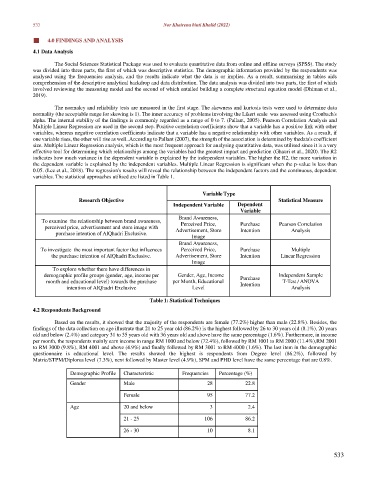
            variables. The statistical approaches utilised are listed in Table 1.


                                                                    Variable Type
                           Research Objective                                                Statistical Measure
                                                          Independent Variable   Dependent
                                                                                 Variable
                                                            Brand Awareness,
               To examine  the relationship between brand awareness,   Perceived Price,
                perceived price, advertisement and store image with   Advertisement, Store   Purchase   Pearson Correlation
                                                                                 Intention
                                                                                                 Analysis
                   purchase intention of AlQhadri Exclusive.
                                                                Image
                                                            Brand Awareness,
              To investigate  the most important factor that influences   Perceived Price,   Purchase   Multiple
                  the purchase intention of AlQhadri Exclusive.   Advertisement, Store   Intention   Linear Regression
                                                                Image
                  To explore whether there have differences in
                demographic profile groups (gender, age, income per   Gender, Age, Income   Purchase   Independent Sample
                month and educational level) towards the purchase   per Month, Educational   Intention   T-Test / ANOVA
                       intention of AlQhadri Exclusive           Level                           Analysis
                                                   Table 1: Statistical Techniques
            4.2 Respondents Background

                   Based on the results, it showed that the majority of the respondents are female (77.2%) higher than male (22.8%). Besides, the
            findings of the data collection on age illustrate that 21 to 25 year old (86.2%) is the highest followed by 26 to 30 years old (8.1%), 20 years
            old and below (2.4%) and category 31 to 35 years old with 36 years old and above have the same percentage (1.6%). Furthermore, in income
            per month, the respondents mainly earn income in range RM 1000 and below (72.4%), followed by RM 1001 to RM 2000 (11.4%), RM 2001
            to RM 3000 (9.8%), RM 4001 and above (4.9%) and finally followed by RM 3001 to RM 4000 (1.6%). The last item in the demographic
            questionnaire  is  educational  level.  The  results  showed  the  highest  is  respondents  from  Degree  level  (86.2%),  followed  by
            Matric/STPM/Diploma level (7.3%), next followed by Master level (4.9%), SPM and PHD level have the same percentage that are 0.8%.

                        Demographic Profile   Characteristic   Frequencies   Percentage (%)
                        Gender            Male                        28          22.8

                                          Female                      95          77.2
                        Age               20 and below                3            2.4

                                          21 - 25                    106          86.2
                                          26 - 30                     10           8.1


                                                                                                               533

