


Page 553 - MARSIUM'21 COMP OF PAPER
P. 553
532                                        Nor Khairena binti Khalid (2022)

                   More  recently,  Gundala  (2010) defined  shop  image  as  the  prominent  features  of  a  specific  store  that  customers  judged  and
            contrasted based on the value of each attribute. Apparently, in recent times, various academics have placed a strong emphasis on shop image
            in order to comprehend its significance in the current retail business context (Theodoridis and Chatzipanagiotou, 2009; Silva and Giraldi,
            2010; Biswal and Sreekumar, 2011; Kumar and Manjunath, 2012; Lin and Liao, 2012).

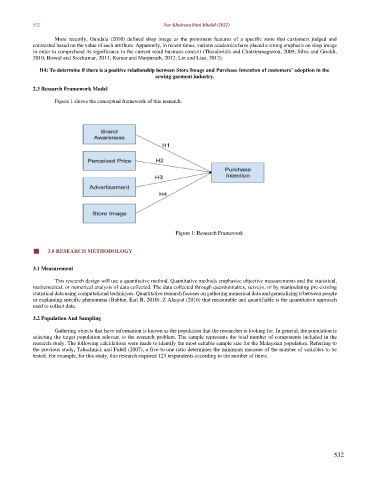
              H4: To determine if there is a positive relationship between Store Image and Purchase Intention of customers’ adoption in the
                                                    sewing garment industry.

            2.3 Research Framework Model

                   Figure 1 shows the conceptual framework of this research.


                                                           Figure 1: Research Framework

            ⬛    3.0 RESEARCH METHODOLOGY


            3.1 Measurement

                   This research design will use a quantitative method. Quantitative methods emphasize objective measurements and the statistical,
            mathematical, or numerical analysis of data collected. The data collected through questionnaires, surveys, or by manipulating pre-existing
            statistical data using computational techniques. Quantitative research focuses on gathering numerical data and generalizing it between people
            or explaining specific phenomena (Babbie, Earl R, 2010). Z Alzayat (2016) that measurable and quantifiable is the quantitative approach
            used to collect data.

            3.2 Population And Sampling

                   Gathering objects that have information is known as the population that the researcher is looking for. In general, the population is
            selecting the target population relevant to the research problem. The sample represents the total number of components included in the
            research study. The following calculations were made to identify the most suitable sample size for the Malaysian population. Referring to
            the previous study, Tabachnick and Fidell (2007), a five-to-one ratio determines the minimum measure of the number of variables to be
            tested. For example, for this study, this research required 123 respondents according to the number of items.


                                                                                                               532

