


Page 673 - MARSIUM'21 COMP OF PAPER
P. 673
652                                        Nursahira (2021)

                mentioned,  can  both  influence  and  predict  the  outcome.  Critic  may  have  the  power  to  influence  consumer  demands  (David  and
                Christopher, 2005).

                Moreover, critics play an essential part in consumer judgments because they provide consumers with preliminary information on product
                previews while also lending them credibility, allowing consumers to be more self-assured in their delivery (West & Broniarczyk 1998).
                It can be in the form of positive or negative reviews.

                In additions, film review especially the negative criticism has a greater effect towards the expectation of filmgoers (Suarez-Vazquez,
                2011).  Negative  criticism,  according  to  Suarez  (2011),  can  influence  viewers'  pre-viewing  sentiments.  Meanwhile,  less  frequent
                moviegoers are more swayed by unfavourable comments than regular moviegoers. This is primarily due to the fact that infrequent
                moviegoers with "mass" tastes outnumber professional critics with "elite" tastes (Holbrook, 2005 cited in Chakrayarty et al, 2010). As
                a result, the following hypothesis was formed:

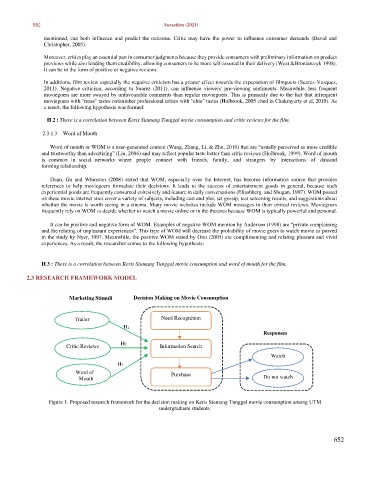
                 H 2 : There is a correlation between Keris Siamang Tunggal movie consumption and critic reviews for the film.

               2.3.1.3  Word of Mouth

                  Word of mouth or WOM is a user-generated content (Wang, Zhang, Li, & Zhu, 2010) that are “usually perceived as more credible
               and trustworthy than advertising” (Liu, 2006) and may reflect popular taste better than critic reviews (Holbrook, 1999). Word of mouth
               is  common  in  social  networks  where   people   connect   with   friends,   family,   and   strangers   by   interactions   of    data and
               forming relationship.

                  Duan,  Gu  and  Whinston  (2008)  stated  that  WOM,  especially  over  the  Internet,  has  become  information  source  that  provides
               references  to  help  moviegoers  formulate  their  decisions.  It  leads  to  the  success  of  entertainment  goods  in  general,  because  such
               experiential goods are frequently consumed cohesively and feature in daily conversations (Eliashberg  and Shugan, 1997). WOM posted
               on these movie internet sites cover a variety of subjects, including cast and plot, set gossip, test screening results, and suggestions about
               whether the movie is worth seeing in a cinema. Many movie websites include WOM messages in their critical reviews. Moviegoers
               frequently rely on WOM to decide whether to watch a movie online or in the theatres because WOM is typically powerful and personal.

                  It can be positive and negative form of WOM. Examples of negative WOM mention by Anderson (1998) are “private complaining
               and the relating of unpleasant experiences”. This type of WOM will decrease the probability of movie goers to watch movie as proved
               in the study by Nyer, 1997. Meanwhile, the positive WOM stated by Otto (2005) are complimenting and relating pleasant and vivid
               experiences. As a result, the researcher comes to the following hypothesis:


               H 3 : There is a correlation between Keris Siamang Tunggal movie consumption and word of mouth for the film.

          2.3 RESEARCH FRAMEWORK MODEL


                        Marketing Stimuli    Decision Making on Movie Consumption


                          Trailer                     Need Recognition
                                          H1
                                                                                        Responses

                       Critic Reviews    H2           Information Search
                                                                                           Watch
                                        H3
                          Word of                         Purchase
                           Mouth                                                        Do not watch


                 Figure 1: Proposed research framework for the decision making on Keris Siamang Tunggal movie consumption among UTM
                                                      undergraduate students.


                                                                                                                652

