


Page 862 - MARSIUM'21 COMP OF PAPER
P. 862
863
            2.2 WEBSITE USER EXPERIENCE

               Recently, academics and industry practitioners in various fields have paid close attention to user experience research. User experience is
            a new term in the field of human-machine interaction. It is now one of the important research topics because the user experience is a key
            factor that gives users a satisfying and pleasant experience when interacting with a product, system, or interface (Zahidi, 2016). Since the
            internet has become a norm, user experience channels have shifted from face-to-face to the virtual world via websites, social media, and
            augmented reality. Alshaheen, (2019) described user experience as “how a person feels when interfacing with a system”. While Pant (2015)
            defined user experience as the overall satisfaction a user gets from interacting with a product or digital tool. Vila et al. (2021), on the other
            hand, discussed that the content of a website, as well as its design and appearance, can improve the user's browsing experience. To put it
            more simply, usability, usefulness, as well as the appealing of the products or services are the major factors that influence the quality of user
            experience.

            As for the children’s experience, they are now regarded as the primary users of the software. Hence, the use of tech is no longer restricted to
            adults (Alrashed & Alhussayen, 2015). The website developers try to construct software that caters to children’s abilities, preferences, and
            development needs (Kaur et al., 2021). According to (Alrashed & Alhussayen, 2015), it is critical to measure children's experience of
            enjoyment with websites because it has a significant outcome on children's view of the website. For this reason, a website with a good user
            experience will have benefits and a strong business value. To the researcher’s knowledge, no studies have been conducted in Malaysia to
            investigate the user experience of tourism websites for children. To fill this research gap, we present preliminary findings from a study on
            Zoo Negara's website users' experiences.

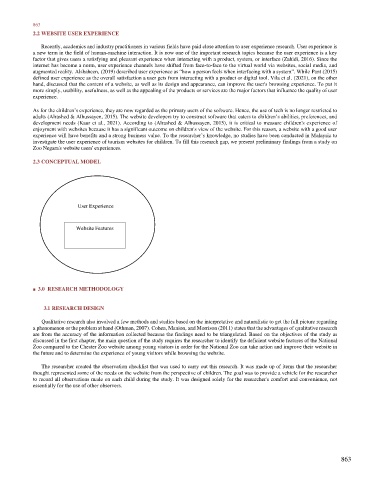
            2.3 CONCEPTUAL MODEL


                           User Experience


                          Website Features


            ■  3.0  RESEARCH METHODOLOGY


               3.1 RESEARCH DESIGN

               Qualitative research also involved a few methods and studies based on the interpretative and naturalistic to get the full picture regarding
            a phenomenon or the problem at hand (Othman, 2007). Cohen, Manion, and Morrison (2011) states that the advantages of qualitative research
            are from the accuracy of the information collected because the findings need to be triangulated. Based on the objectives of the study as
            discussed in the first chapter, the main question of the study requires the researcher to identify the deficient website features of the National
            Zoo compared to the Chester Zoo website among young visitors in order for the National Zoo can take action and improve their website in
            the future and to determine the experience of young visitors while browsing the website.

               The researcher created the observation checklist that was used to carry out this research. It was made up of items that the researcher
            thought represented some of the needs on the website from the perspective of children. The goal was to provide a vehicle for the researcher
            to record all observations made on each child during the study. It was designed solely for the researcher's comfort and convenience, not
            essentially for the use of other observers.


                                                                                                                  863

