


Page 863 - MARSIUM'21 COMP OF PAPER
P. 863
864

               3.2 POPULATION AND SAMPLING

               According to Kenton (2021), a sample is a random selection of observations from a population. Probability sampling and non-probability
            sampling are the two types of sampling. However, non-probability sampling is usually carried out by observation, and researchers use it
            widely for qualitative research. This method allows the researcher to gain better insight from the right respondents.

               This study sample consisted of a total of 15 children. These children range in age from 7 to 12 years because as mentioned by Amirul
            Asyraf, the person in charge of the Education Department of Zoo Negara the most visitors coming from children. To protect the children’s
            anonymity, all information about them is kept hidden, including their names. This is also due to the request from the parents of the children
            themselves.

               3.2 RESEARCH INSTRUMENTS

               The data was collected using the observation method. This study adopted the research method by Lanik (2000) on the prediction of child
            maltreatment using the checklist. The checklists used in his research were made up of 45 “yes” and “no” that is divided into six categories.
            On the other hand, the instrument for this study is composed of 15 "yes" or "no" items divided into four categories. To make the process as
            simple as possible, all methods for this observation checklist will be performed on an iPad. To begin the observation checklist, children were
            approached and asked to browse the Zoo Negara website. They will then fill out the Google Forms form (see Appendix A). After completing
            the first observation checklist in Google Form, they must proceed to the Chester Zoo's website for the next step. Finally, they will complete
            the observation checklist in the Google Form as given before, with the only difference being that at the end of the question, they will be asked
            is  "I  choose  the  Chester  Zoo’s  website  than  the  Zoo  Negara’s  website”.  To  provide  guidance,  respondents  completed  a  checklist  of
            observations in a quiet area with their caregivers.

            The observation checklist is divided into two sections:

                   •   Section A: Website Features

                   •   Section B: Website User Experience

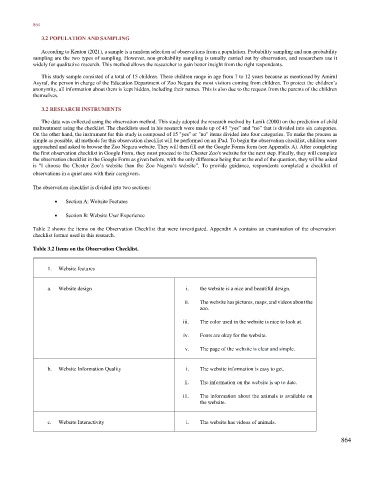
            Table 2 shows the items on the Observation Checklist that were investigated. Appendix A contains an examination of the observation
            checklist format used in this research.

            Table 3.2 Items on the Observation Checklist.


                 1.   Website features

                 a.   Website design                           i.   the website is a nice and beautiful design.

                                                              ii.   The website has pictures, maps, and videos about the
                                                                   zoo.

                                                              iii.   The color used in the website is nice to look at.

                                                              iv.   Fonts are okay for the website.

                                                              v.   The page of the website is clear and simple.


                 b.   Website Information Quality              i.   The website information is easy to get.

                                                              ii.   The information on the website is up to date.

                                                              iii.   The information about the animals is available on
                                                                   the website.


                 c.   Website Interactivity                    i.   The website has videos of animals.


                                                                                                                  864

