


Page 27 - Essentials of Nursing Leadership and Management, 5th Edition
P. 27
CikguOnline
         2208_Ch02_013-020.qxd  11/6/09  5:54 PM  Page 14
               14   unit 1 | Professional Considerations                                                                   CikguOnline
               Every nurse should be a good leader and a good  name implies, the human-relations approach
               follower. Not everyone should be a manager, how-  emphasizes the interpersonal aspects of managing
               ever. In fact, new graduates simply are not ready to  people, whereas scientific management emphasizes
               take on management responsibilities. Once you  the task aspects.
               have had time to develop your clinical and leader-
               ship skills, you can begin to think about taking on  Scientific Management
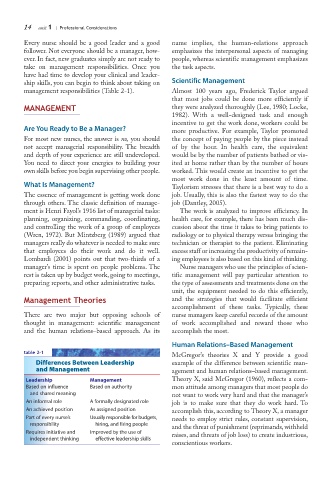
               management responsibilities (Table 2-1).     Almost 100 years ago, Frederick  Taylor argued
                                                            that  most jobs could be done more efficiently if
               MANAGEMENT                                   they were analyzed thoroughly (Lee, 1980; Locke,
                                                            1982). With a well-designed task and enough
                                                            incentive to get the work done, workers could be
               Are You Ready to Be a Manager?               more productive. For example, Taylor promoted
               For most new nurses, the answer is no, you should  the concept of paying people by the piece instead
               not accept managerial responsibility. The breadth  of by the hour. In health care, the equivalent
               and depth of your experience are still undeveloped.  would be by the number of patients bathed or vis-
               You need to direct your energies to building your  ited at home rather than by the number of hours
               own skills before you begin supervising other people.  worked. This would create an incentive to get the
                                                            most work done in the least amount of time.
               What Is Management?                          Taylorism stresses that there is a best way to do a
               The essence of management is getting work done  job. Usually, this is also the fastest way to do the
               through others. The classic definition of manage-  job (Dantley, 2005).
               ment is Henri Fayol’s 1916 list of managerial tasks:  The work is analyzed to improve efficiency. In
               planning, organizing, commanding, coordinating,  health care, for example, there has been much dis-
               and controlling the work of a group of employees  cussion about the time it takes to bring patients to
               (Wren, 1972). But Mintzberg (1989) argued that  radiology or to physical therapy versus bringing the
               managers really do whatever is needed to make sure  technician or therapist to the patient. Eliminating
               that employees do their work and do it well.  excess staff or increasing the productivity of remain-
               Lombardi (2001) points out that two-thirds of a  ing employees is also based on this kind of thinking.
               manager’s time is spent on people problems. The  Nurse managers who use the principles of scien-
               rest is taken up by budget work, going to meetings,  tific management will pay particular attention to
               preparing reports, and other administrative tasks.  the type of assessments and treatments done on the
                                                            unit, the equipment needed to do this efficiently,
               Management Theories                          and the strategies that would facilitate efficient
                                                            accomplishment of these tasks. Typically, these
               There are two major but opposing schools of  nurse managers keep careful records of the amount
               thought in management: scientific management  of work accomplished and reward those who
               and the human relations–based approach. As its  accomplish the most.

                                                            Human Relations–Based Management
               table 2-1
                                                            McGregor’s theories X and  Y provide a good
                   Differences Between Leadership           example of the difference between scientific man-
                   and Management                           agement and human relations–based management.
                Leadership         Management               Theory X, said McGregor (1960), reflects a com-
                Based on influence   Based on authority     mon attitude among managers that most people do
                 and shared meaning                         not want to work very hard and that the manager’s
                An informal role   A formally designated role  job is to make sure that they do work hard. To
                An achieved position  As assigned position  accomplish this, according to Theory X, a manager
                Part of every nurse’s   Usually responsible for budgets,  needs to employ strict rules, constant supervision,
                 responsibility      hiring, and firing people
                                                            and the threat of punishment (reprimands,withheld
                Requires initiative and   Improved by the use of  raises, and threats of job loss) to create industrious,
                 independent thinking  effective leadership skills
                                                            conscientious workers.

