


Page 494 - alligood 8th edition_Neat
P. 494
CHAPTER 24  Rosemarie Rizzo Parse  475

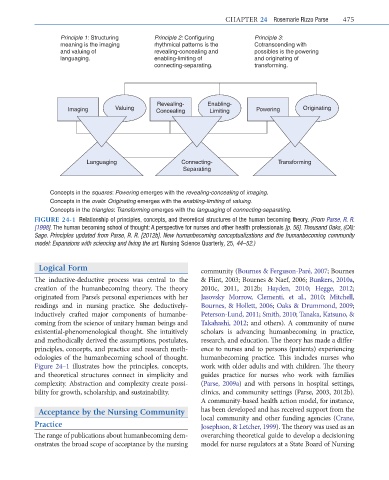
                  Principle 1: Structuring  Principle 2: Configuring    Principle 3:
                  meaning is the imaging    rhythmical patterns is the  Cotranscending with
                  and valuing of            revealing-concealing and    possibles is the powering
                  languaging.               enabling-limiting of        and originating of
                                            connecting-separating.      transforming.


                                             Revealing-    Enabling-
                    Imaging      Valuing    Concealing     Limiting     Powering     Originating


                         Languaging                Connecting-                Transforming
                                                    Separating


               Concepts in the squares: Powering emerges with the revealing-concealing of imaging.
               Concepts in the ovals: Originating emerges with the enabling-limiting of valuing.
               Concepts in the triangles: Transforming emerges with the languaging of connecting-separating.
           FIGURE 24-1   Relationship of principles, concepts, and theoretical structures of the human becoming theory. (From Parse, R. R.
           [1998]. The human becoming school of thought: A perspective for nurses and other health professionals [p. 56]. Thousand Oaks, (CA):
           Sage. Principles updated from Parse, R. R. [2012b]. New humanbecoming conceptualizations and the humanbecoming community
           model: Expansions with sciencing and living the art. Nursing Science Quarterly, 25, 44–52.)


            Logical Form                                 community (Bournes & Ferguson-Paré, 2007; Bournes
           The  inductive-deductive  process  was  central  to  the    & Flint, 2003; Bournes & Naef, 2006; Bunkers, 2010a,
           creation  of  the  humanbecoming  theory.  The  theory   2010c,  2011,  2012b;  Hayden,  2010;  Hegge,  2012;
           originated from Parse’s personal experiences with her   Jasovsky  Morrow,  Clementi,  et  al.,  2010;  Mitchell,
           readings  and  in  nursing  practice.  She  deductively-   Bournes, & Hollett, 2006; Oaks & Drummond, 2009;
           inductively  crafted  major  components  of  humanbe-  Peterson-Lund, 2011; Smith, 2010; Tanaka, Katsuno, &
           coming from the science of unitary human beings and   Takahashi, 2012; and others). A community of nurse
           existential-phenomenological  thought.  She  intuitively   scholars  is  advancing  humanbecoming  in  practice,
           and methodically derived the assumptions, postulates,   research, and education. The theory has made a differ-
           principles, concepts, and practice and research meth-  ence to nurses and to persons (patients) experiencing
           odologies of the humanbecoming school of thought.   humanbecoming  practice.  This  includes  nurses  who
           Figure  24–1  illustrates  how  the  principles,  concepts,   work with older adults and with children. The theory
           and  theoretical  structures  connect  in  simplicity  and   guides  practice  for  nurses  who  work  with  families
           complexity. Abstraction and complexity create possi-  (Parse,  2009a)  and  with  persons  in  hospital  settings,
           bility for growth, scholarship, and sustainability.  clinics, and community settings (Parse, 2003, 2012b).
                                                         A community-based health action model, for instance,
            Acceptance by the Nursing Community          has been developed and has received support from the
                                                         local community and other funding agencies (Crane,
           Practice                                      Josephson, & Letcher, 1999). The theory was used as an
           The range of publications about humanbecoming dem-  overarching theoretical guide to develop a decisioning
           onstrates the broad scope of acceptance by the nursing   model for nurse regulators at a State Board of Nursing

