


Page 521 - alligood 8th edition_Neat
P. 521
502    UNIT IV  Nursing Theories

            MAJOR CONCEPTS & DEFINITIONS—cont’d

            Mind-Body Relationships                      or  her  effectiveness  or  fulfillment  (given  circum-
            We  are  all  biophysical,  psychosocial  beings  who   stances),  or  promote  his  or  her  growth  (Erickson,
            want to develop our potential, that is, to be the best   Tomlin, & Swain, 2002, p. 48).
            we can be (Erickson, Tomlin, & Swain, 2002, p. 70).  n	 Self-Care Resources
                                                           Self-care resources are “the internal resources, as
            Self-Care                                    well as additional resources, mobilized through self-
            Self-care involves the use of knowledge, resources,   care action that help gain, maintain, and promote an
            and actions, as follows:                     optimum level of holistic health” (Erickson, Tomlin,
            n	 Self-Care Knowledge                       & Swain, 2002, pp. 254–255).
              At  some  level,  a  person  knows  what  has  made   n	 Self-Care Action
            him or her sick, lessened his or her effectiveness, or   Self-care action is “the development and utiliza-
            interfered with his or her growth. The person also   tion of self-care knowledge and self-care resources”
            knows what will make him or her well, optimize his   (Erickson, Tomlin, & Swain, 2002, p. 254).


            Use of Empirical Evidence
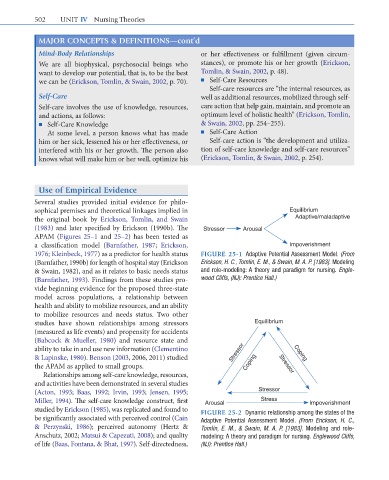
           Several  studies  provided  initial  evidence  for  philo-
           sophical premises and theoretical linkages implied in                 Equilibrium
           the  original  book  by  Erickson,  Tomlin,  and  Swain                 Adaptive/maladaptive
           (1983) and later specified by Erickson (1990b). The   Stressor  Arousal
           APAM  (Figures  25–1  and  25–2)  has  been  tested  as
           a  classification  model  (Barnfather,  1987;  Erickson,              Impoverishment
           1976; Kleinbeck, 1977) as a predictor for health status   FIGURE 25-1   Adaptive Potential Assessment Model. (From
           (Barnfather, 1990b) for length of hospital stay (Erickson   Erickson, H. C., Tomlin, E. M., & Swain, M. A. P. [1983]. Modeling
           & Swain, 1982), and as it relates to basic needs status   and role-modeling: A theory and paradigm for nursing. Engle-
           (Barnfather, 1993). Findings from these studies pro-  wood Cliffs, (NJ): Prentice Hall.)
           vide beginning evidence for the proposed three-state
           model  across  populations,  a  relationship  between
           health and ability to mobilize resources, and an ability
           to  mobilize  resources  and  needs  status.  Two  other
           studies  have  shown  relationships  among  stressors        Equilibrium
           (measured as life events) and propensity for accidents
           (Babcock  &  Mueller,  1980)  and  resource  state  and
           ability to take in and use new information (Clementino   Stressor
           & Lapinske, 1980). Benson (2003, 2006, 2011) studied                    Coping
           the APAM as applied to small groups.                      Coping   Stressor
             Relationships among self-care knowledge, resources,
           and activities have been demonstrated in several studies
           (Acton,  1993;  Baas,  1992;  Irvin,  1993;  Jensen,  1995;   Stressor
           Miller, 1994). The self-care knowledge construct, first   Arousal  Stress   Impoverishment
           studied by Erickson (1985), was replicated and found to   FIGURE 25-2   Dynamic relationship among the states of the
           be significantly associated with perceived control (Cain   Adaptive  Potential  Assessment  Model.  (From  Erickson,  H.  C.,
           &  Perzynski,  1986);  perceived  autonomy  (Hertz  &   Tomlin, E. M., & Swain, M. A. P. [1983]. Modeling and role-
           Anschutz, 2002; Matsui & Capezuti, 2008); and quality   modeling: A theory and paradigm for nursing. Englewood Cliffs,
           of life (Baas, Fontana, & Bhat, 1997). Self-directedness,   (NJ): Prentice Hall.)

