


Page 12 - Hsslive-Plus-One-Physics-Class-Notes-Part-III (1)
P. 12
Heat, Thermodynamics & Kinetic Theory {11} Vinodkumar M, St. Aloysius H.S.S, Elthuruth, Thrissur.
Heat Engines
Heat engines converts heat energy into mechanical energy.
Heat engine is a device by which a system is made to undergo a cyclic process that results in conversion of
heat to work.
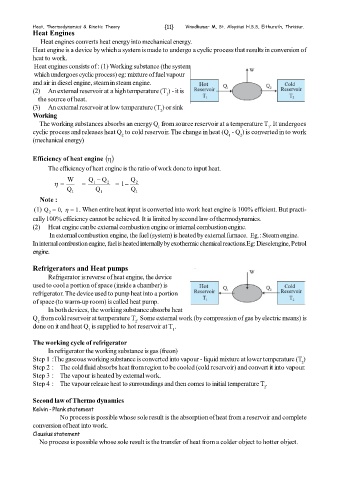
Heat engines consists of : (1) Working substance (the system
which undergoes cyclic process) eg: mixture of fuel vapour
and air in diesel engine, steam in steam engine.
(2) An external reservoir at a high temperature (T ) - it is
1
the source of heat.
(3) An external reservoir at low temperature (T ) or sink
2
Working
The working substances absorbs an energy Q from source reservoir at a temperature T . It undergoes
1 1
cyclic process and releases heat Q to cold reservoir. The change in heat (Q - Q ) is converted in to work
2 1 2
(mechanical energy)
Efficiency of heat engine
The efficiency of heat engine is the ratio of work done to input heat.
W Q Q Q
1 2 1 2
Q Q Q
1 1 1
Note :
(1) Q 0, 1. When entire heat input is converted into work heat engine is 100% efficient. But practi-
2
cally 100% efficiency cannot be achieved. It is limited by second law of thermodynamics.
(2) Heat engine can be external combustion engine or internal combustion engine.
In external combustion engine, the fuel (system) is heated by external furnace. Eg.: Steam engine.
In internal combustion engine, fuel is heated internally by exothermic chemical reactions.Eg: Diesel engine, Petrol
engine.
Refrigerators and Heat pumps
Refrigerator is reverse of heat engine, the device
used to cool a portion of space (inside a chamber) is
refrigerator. The device used to pump heat into a portion
of space (to warm-up room) is called heat pump.
In both devices, the working substance absorbs heat
Q from cold reservoir at temperature T . Some external work (by compression of gas by electric means) is
2 2
done on it and heat Q is supplied to hot reservoir at T .
1 1
The working cycle of refrigerator
In refrigerator the working substance is gas (freon)
Step 1 :The gaseous working substance is converted into vapour - liquid mixture at lower temperature (T )
2
Step 2 : The cold fluid absorbs heat from region to be cooled (cold reservoir) and convert it into vapour.
Step 3 : The vapour is heated by external work.
Step 4 : The vapour release heat to surroundings and then comes to initial temperature T .
2
Second law of Thermo dynamics
Kelvin - Plank statement
No process is possible whose sole result is the absorption of heat from a reservoir and complete
conversion of heat into work.
Clausius statement
No process is possible whose sole result is the transfer of heat from a colder object to hotter object.

