


Page 10 - Hsslive-Plus-One-Physics-Class-Notes-Part-III (1)
P. 10
Heat, Thermodynamics & Kinetic Theory {9} Vinodkumar M, St. Aloysius H.S.S, Elthuruth, Thrissur.
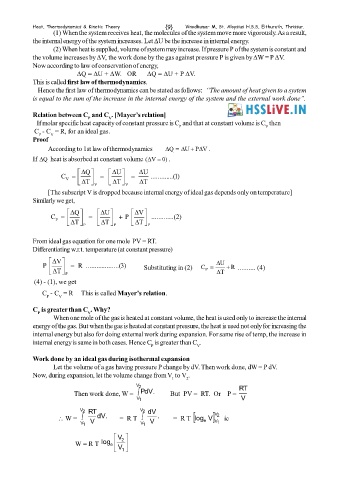
(1) When the system receives heat, the molecules of the system move more vigorously. As a result,
the internal energy of the system increases. Let U be the increase in internal energy.
(2) When heat is supplied, volume of system may increase. If pressure P of the system is constant and
the volume increases by V, the work done by the gas against pressure P is given by W = P V.
Now according to law of conservation of energy,
Q = U + W. OR Q = U + P V.
This is called first law of thermodynamics.
Hence the first law of thermodynamics can be stated as follows: “The amount of heat given to a system
is equal to the sum of the increase in the internal energy of the system and the external work done”.
Relation between C and C . [Mayer’s relation]
P V
If molar specific heat capacity of constant pressure is C and that at constant volume is C then
P V
C - C = R, for an ideal gas.
P V
Proof
According to 1st law of thermodynamics Q U P V .
If Q heat is absorbed at constant volume (V 0 .
)
Q U U
C .......... ...( ) 1
V
T V T V T
[The subscript V is dropped because internal energy of ideal gas depends only on temperature]
Similarly we get,
Q U V
C P .......... ...( ) 2
P
T P T P T P
From ideal gas equation for one mole PV = RT.
Differentiating w.r.t. temperature (at constant pressure)
V U
P R .......... .........( ) 3 Substituting in (2) C R .......... (4)
P
T P T
(4) - (1), we get
C - C = R This is called Mayer’s relation.
P V
C is greater than C . Why?
P V
When one mole of the gas is heated at constant volume, the heat is used only to increase the internal
energy of the gas. But when the gas is heated at constant pressure, the heat is used not only for increasing the
internal energy but also for doing external work during expansion. For same rise of temp, the increase in
internal energy is same in both cases. Hence C is greater than C .
P V
Work done by an ideal gas during isothermal expansion
Let the volume of a gas having pressure P change by dV. Then work done, dW = P dV.
Now, during expansion, let the volume change from V to V .
1 2
V 2 R T
Then work done, W = dVP . But PV = RT. Or P =
V 1 V
V 2 R T V 2 dV
W = dV . = R T . = R T log V V 2 ie
V V V V e V 1
1
1
V 2
W = R T log e
V 1 

