


Page 133 - Class-11-Physics-Part-1_Neat
P. 133
WORK, ENERGY AND POWER 119
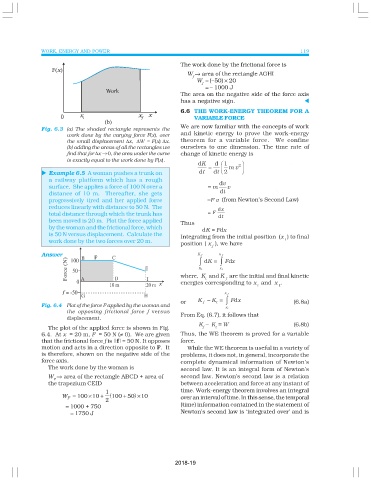
The work done by the frictional force is
W → area of the rectangle AGHI
f
W = (−50) × 20
f
= − 1000 J
The area on the negative side of the force axis
has a negative sign. t
6.6 THE WORK-ENERGY THEOREM FOR A
VARIABLE FORCE
We are now familiar with the concepts of work
Fig. 6.3 (a) The shaded rectangle represents the
work done by the varying force F(x), over and kinetic energy to prove the work-energy
the small displacement ∆x, ∆W = F(x) ∆x. theorem for a variable force. We confine
(b) adding the areas of all the rectangles we ourselves to one dimension. The time rate of
find that for ∆x → 0, the area under the curve change of kinetic energy is
is exactly equal to the work done by F(x).
dK d 1
= m v 2
Example 6.5 A woman pushes a trunk on dt dt 2
t
a railway platform which has a rough dv
surface. She applies a force of 100 N over a = m v
distance of 10 m. Thereafter, she gets dt
progressively tired and her applied force F= v (from Newton’s Second Law)
reduces linearly with distance to 50 N. The dx
total distance through which the trunk has = F dt
been moved is 20 m. Plot the force applied
Thus
by the woman and the frictional force, which
dK = Fdx
is 50 N versus displacement. Calculate the
Integrating from the initial position (x ) to final
work done by the two forces over 20 m. i
position ( x ), we have
f
Answer K f x f
∫ dK = ∫ F dx
K i x i
where, K and K are the initial and final kinetic
i f
energies corresponding to x and x .
i f
x f
K − K = ∫ F x
d
or f i (6.8a)
Fig. 6.4 Plot of the force F applied by the woman and
x i
the opposing frictional force f versus
From Eq. (6.7), it follows that
displacement.
K − K = W (6.8b)
The plot of the applied force is shown in Fig. f i
6.4. At x = 20 m, F = 50 N (≠ 0). We are given Thus, the WE theorem is proved for a variable
that the frictional force f is |f|= 50 N. It opposes force.
motion and acts in a direction opposite to F. It While the WE theorem is useful in a variety of
is therefore, shown on the negative side of the problems, it does not, in general, incorporate the
force axis. complete dynamical information of Newton’s
The work done by the woman is second law. It is an integral form of Newton’s
W → area of the rectangle ABCD + area of second law. Newton’s second law is a relation
F
the trapezium CEID between acceleration and force at any instant of
1 time. Work-energy theorem involves an integral
+
W = 100 ×10 + (100 50 ) ×10 over an interval of time. In this sense, the temporal
F
2
= 1000 + 750 (time) information contained in the statement of
= 1750 J Newton’s second law is ‘integrated over’ and is
2018-19

