


Page 131 - Class-11-Physics-Part-1_Neat
P. 131
WORK, ENERGY AND POWER                                                                     117

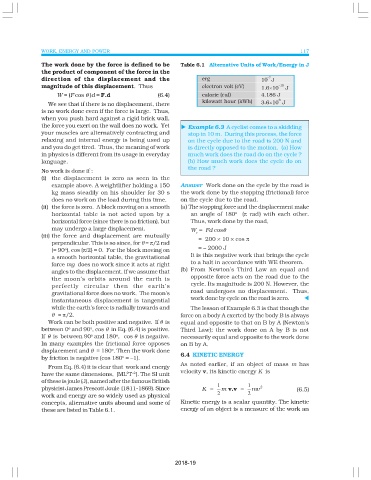
                The work done by the force is defined to be      Table 6.1   Alternative Units of Work/Energy in J
                the product of component of the force in the
                direction of the displacement and the
                magnitude of this displacement.  Thus
                     W = (F cos θ )d = F.d               (6.4)
                  We see that if there is no displacement, there
                is no work done even if the force is large.  Thus,
                when you push hard against a rigid brick wall,
                the force you exert on the wall does no work.  Yet  t  Example 6.3  A cyclist comes to a skidding
                your muscles are alternatively contracting and      stop in 10 m.  During this process, the force
                relaxing and internal energy is being used up       on the cycle due to the road is 200 N and
                and you do get tired.  Thus, the meaning of work    is directly opposed to the motion.  (a) How
                in physics is different from its usage in everyday  much work does the road do on the cycle ?
                language.                                           (b) How much work does the cycle do on
                                                                    the road ?
                No work is done if :
                (i) the displacement is zero as seen in the
                   example above. A weightlifter holding a 150   Answer  Work done on the cycle by the road is
                   kg mass steadily on his shoulder for 30 s     the work done by the stopping (frictional) force
                   does no work on the load during this time.    on the cycle due to the road.
                (ii) the force is zero.  A block moving on a smooth  (a) The stopping force and the displacement make
                   horizontal table is not acted upon by a           an angle of 180 o  (π  rad) with each other.
                   horizontal force (since there is no friction), but  Thus, work done by the road,
                   may undergo a large displacement.                 W  =  Fd cosθ
                                                                       r
                (iii) the force and displacement are mutually             =  200 × 10 × cos π
                   perpendicular. This is so since, for θ = π/2 rad
                   (= 90 ), cos (π/2) = 0.  For the block moving on        = – 2000 J
                        o
                   a smooth horizontal table, the gravitational      It is this negative work that brings the cycle
                                                                     to a halt in accordance with WE theorem.
                   force mg  does no work since it acts at right
                                                                 (b) From Newton’s Third Law an equal and
                   angles to the displacement. If we assume that
                   the moon’s orbits around the earth is             opposite force acts on the road due to the
                   perfectly circular then the earth’s               cycle. Its magnitude is 200 N. However, the
                                                                     road undergoes no displacement.     Thus,
                   gravitational force does no work.  The moon’s
                   instantaneous displacement is tangential          work done by cycle on the road is zero.            t
                   while the earth’s force is radially inwards and   The lesson of Example 6.3 is that though the
                   θ  = π/2.                                     force on a body A exerted by the body B is always
                  Work can be both positive and negative.  If θ  is  equal and opposite to that on B by A (Newton’s
                between 0  and 90 , cos θ  in Eq. (6.4) is positive.  Third Law); the work done on A by B is not
                                 o
                         o
                                          o
                                 o
                If  θ  is  between 90  and 180 ,   cos θ  is negative.  necessarily equal and opposite to the work done
                In many examples the frictional force opposes    on B by A.
                                         o
                displacement and θ  = 180 . Then the work done
                                                                 6.4  KINETIC ENERGY
                                            o
                by friction is negative (cos 180  = –1).
                                                                 As noted earlier, if an object of mass m  has
                  From Eq. (6.4) it is clear that  work and energy
                                                                 velocity v, its kinetic energy K  is
                                                –2
                                              2
                have the same dimensions,  [ML T ]. The SI unit
                of these is joule (J), named after the famous British         1          1
                                                                                             2
                physicist James Prescott Joule  (1811-1869). Since       K =   m v v  =   mv                        (6.5)
                                                                                   .
                work and energy are so widely used as physical                2          2
                concepts, alternative units abound and some of   Kinetic energy is a scalar quantity. The kinetic
                these are listed in Table 6.1.                   energy of an object is a measure of the work an


                                                               2018-19

