


Page 134 - Class-11-Physics-Part-1_Neat
P. 134
120                                                                                    PHYSICS

                       not available explicitly. Another observation is that  are like ‘compressed springs’. They possess a
                       Newton’s second law for two or three dimensions  large amount of potential energy. An earthquake
                       is in vector form whereas the work-energy        results when these fault lines readjust. Thus,
                       theorem is in scalar form. In the scalar form,   potential energy is the ‘stored energy’ by virtue
                       information with respect to directions contained  of the position or configuration of a body. The
                       in Newton’s second law is not present.           body left to itself releases this stored energy in
                                                                        the form of kinetic energy. Let us make our notion
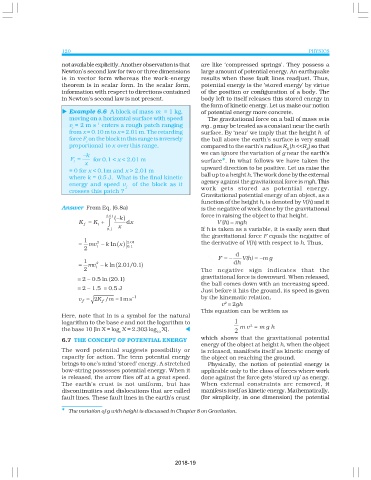
                          Example 6.6  A block of mass m  = 1 kg,       of potential energy more concrete.
                         t
                          moving on a horizontal surface with speed        The gravitational force on a ball of mass m is
                                   –1
                          v  = 2 m s  enters a rough patch ranging      mg . g may be treated as a constant near the earth
                           i
                          from x = 0.10 m to x = 2.01 m. The retarding  surface. By ‘near’ we imply that the height h  of
                          force F  on the block in this range is inversely  the ball above the earth’s surface is very small
                                r
                          proportional  to x  over this range,          compared to the earth’s radius R (h <<R ) so that
                                                                                                       E      E
                              − k                                       we can ignore the variation of g near the earth’s
                          F =
                           r       for 0.1 < x < 2.01 m                 surface*. In what follows we have taken the
                               x
                          = 0 for x < 0.1m and x > 2.01 m               upward direction to be positive. Let us raise the
                          where k = 0.5 J.  What is the final kinetic   ball up to a height h. The work done by the external
                          energy and speed v    of the block as it      agency against the gravitational force is mgh. This
                                              f                         work gets stored as potential energy.
                          crosses this patch ?
                                                                        Gravitational potential energy of an object, as a
                                                                        function of the height h, is denoted by V(h) and it
                       Answer  From Eq. (6.8a)                          is the negative of work done by the gravitational
                                      2.01  − (  k)                     force in raising the object to that height.
                             K =  K +  ∫      d x
                               f    i                                         V (h) = mgh
                                       0.1  x                           If h is taken as a variable, it is easily seen that
                                                                        the gravitational force F equals the negative of
                               1
                                           ( )
                                   2
                             =  mv −  k  ln x  2.01                     the derivative of V(h) with respect to h. Thus,
                                   i
                                              0.1
                               2
                                                                                    d
                                                                              F = −    V(h) = − m g
                               1                                                    dh
                                   2
                             =  mv −  k  ln  (2.01/0.1 )
                               2   i                                    The negative sign indicates that the
                                                                        gravitational force is downward. When released,
                             = 2 − 0.5 ln (20.1)
                                                                        the ball comes down with an increasing speed.
                             = 2 − 1.5  = 0.5 J
                                                                        Just before it hits the ground, its speed is given
                             v f  =  2K  f  /m  =    1 m  s − 1         by the kinematic relation,
                                                                               v  = 2gh
                                                                                2
                                                                        This equation can be written as
                       Here, note that ln is a symbol for the natural
                       logarithm to the base e and not the logarithm to             1     2
                       the base 10 [ln X = log  X = 2.303 log  X].  t                 m v  = m g h
                                           e            10                          2
                                                                        which shows that the gravitational potential
                       6.7  THE CONCEPT OF POTENTIAL ENERGY
                                                                        energy of the object at height h, when the object
                       The word potential suggests possibility or       is released, manifests itself as kinetic energy of
                       capacity for action. The term potential energy   the object on reaching the ground.
                       brings to one’s mind ‘stored’ energy. A stretched   Physically, the notion of potential energy is
                       bow-string possesses potential energy. When it   applicable only to the class of forces where work
                       is released, the arrow flies off at a great speed.  done against the force gets ‘stored up’ as energy.
                       The earth’s crust is not uniform, but has        When external constraints are removed, it
                       discontinuities and dislocations that are called  manifests itself as kinetic energy. Mathematically,
                       fault lines. These fault lines in the earth’s crust  (for simplicity, in one dimension) the potential
                       * The variation of g with height is discussed in Chapter 8 on Gravitation.


                                                               2018-19

