


Page 132 - Class-11-Physics-Part-1_Neat
P. 132
118                                                                                    PHYSICS

                                                     Table 6.2  Typical kinetic energies (K)


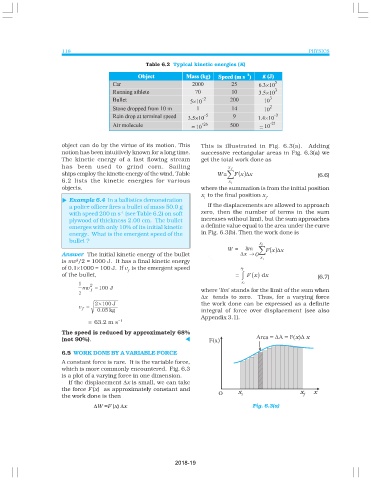
                       object can do by the virtue of its motion. This  This is illustrated in Fig. 6.3(a).   Adding
                       notion has been intuitively known for a long time.  successive rectangular areas in Fig. 6.3(a) we
                       The kinetic energy of a fast flowing stream      get the total work done as
                       has been used to grind corn. Sailing                       x
                                                                                   f
                       ships employ the kinetic energy of the wind. Table     W  ≅ ∑ F ( )∆x                      (6.6)
                                                                                      x
                       6.2 lists the kinetic energies for various                  i x
                       objects.                                         where the summation is from the initial position
                                                                        x  to the final position x .
                          Example 6.4  In a ballistics demonstration     i                     f
                         t
                          a police officer fires a bullet of mass 50.0 g   If the displacements are allowed to approach
                                            -1
                          with speed 200 m s  (see Table 6.2) on soft   zero, then the number of terms in the sum
                          plywood of thickness 2.00 cm.  The bullet     increases without limit, but the sum approaches
                          emerges with only 10% of its initial kinetic  a definite value equal to the area under the curve
                          energy.  What is the emergent speed of the    in Fig. 6.3(b). Then the work done is
                          bullet ?
                                                                                        lim  x f
                                                                                  W =   lim  ∑ F ( )∆x
                                                                                                 x
                       Answer  The initial kinetic energy of the bullet               ∆ x → 0
                       is mv /2 = 1000 J.  It has a final kinetic energy                      i x
                            2
                       of 0.1×1000 = 100 J.  If v   is the emergent speed             x f
                                              f
                                                                                     =
                       of the bullet,                                                    ∫  F x                   (6.7)
                                                                                          ( ) xd
                             1   2                                                    x i
                              mv  f  = 100 J
                             2                                          where ‘lim’ stands for the limit of the sum when
                                                                        ∆x  tends to zero.  Thus, for a varying force
                                   2× 100    J                          the work done can be expressed as a definite
                             v f  =  . 0  05   kg                       integral of force over displacement (see also
                                                                        Appendix 3.1).
                                       =  63.2 m s  –1
                       The speed is reduced by approximately 68%
                       (not 90%).                                                                      t

                       6.5  WORK DONE BY A VARIABLE FORCE
                       A constant force is rare.  It is the variable force,
                       which is more commonly encountered.  Fig. 6.3
                       is a plot of a varying force in one dimension.
                         If the displacement ∆x is small, we can take
                       the force F (x)  as approximately constant and
                       the work done is then
                                  ∆W =F (x) ∆x                                             Fig. 6.3(a)


                                                               2018-19

