Page 166 - Class-11-Physics-Part-1_Neat
P. 166
152                                                                                    PHYSICS

                          From this follow the results
                                                                                        ˆ i  ˆ j  k
                                                                                                ˆ
                                                    ˆ
                                          ˆ
                                                ˆ
                                          j
                           (i)  × =i ˆ ˆ i  , 0 j ˆ  × =  , 0 k  × k  = 0
                                                                                                         ˆ
                                                                                                             ˆ
                                                                                                      ˆ
                                                                                                         j
                                                                                a  × b  =  3  − 4  5 =  7 − −  5k
                                                                                                      i
                                    ˆ
                          (ii)  × =i ˆ  ˆ j  k                                         − 2  1  − 3
                          Note that the magnitude of  ×i ˆ  ˆ j  is sin90 0
                                                                                                  ˆ
                                                                                              ˆ
                                                                                           ˆ
                                                                            Note   b  × a  = − 7 + +  5k          t
                                                                                              j
                                                                                           i
                       or 1, since ˆ  i  and    ˆ j  both have unit
                       magnitude and the angle between them is 90 .     7.6 ANGULAR        VELOCITY       AND     ITS
                                                                   0
                       Thus, i ˆ  × j ˆ  is a unit vector. A unit vector     RELATION WITH LINEAR VELOCITY
                                                                        In this section we shall study what is angular
                                                              ˆ
                       perpendicular to the plane of ˆ i  and j  and    velocity and its role in rotational motion. We
                       related to them by the right hand screw rule is  have seen that every particle of a rotating body
                                                                        moves in a circle. The linear velocity of the
                        ˆ . Hence, the above result. You may verify
                       k                                                particle is related to the angular velocity. The
                       similarly,
                                                                        relation between these two quantities involves
                              ˆ
                           ˆ j  × k  = i ˆ  and k  × = j                a vector product which we learnt about in the
                                             ˆ
                                                ˆ
                                          ˆ
                                             i
                          From the rule for commutation of the cross    last section.
                       product, it follows:                                 Let us go back to Fig. 7.4. As said above, in
                                                                        rotational motion of a rigid body about a fixed
                                      ˆ
                                                    ˆ
                                                        ˆ
                                         ˆ
                           ˆ j  × = −k , k  × = −i ˆ , i ˆ  × k  = − j  axis, every particle of the body moves in a circle,
                              ˆ
                                  ˆ
                                         j
                              i
                                  ˆ ˆ ˆ
                          Note if , ,i j k occur cyclically in the above
                       vector product relation, the vector product is
                                  ˆ ˆ ˆ
                       positive. If  , ,i j k  do not occur in cyclic order,
                       the vector product is negative.
                          Now,
                                            ˆ
                                                            ˆ
                       a  × b  =  (a i ˆ +  a j ˆ +  a k ) (b×  x ˆ i +  b j ˆ +  b k )
                                          z
                                                      y
                                                           z
                                x
                                     y
                                             ˆ
                              ˆ
                                     ˆ
                       =  a b k  −  a b j  −  a b k  +  a b i ˆ  +  a b j ˆ  −  a b i ˆ
                          x  y    x  z   y  x    y  z   z  x   z  y
                                                                 ˆ
                       =(a b −  a b y  )i ˆ  + (a b −  a b  z )j ˆ  + (a b −  a b x  )k
                                z
                                                         y
                            z
                                                       x
                                                             y
                          y
                                           x
                                               x
                                         z
                          We have used the elementary cross products
                       in obtaining the above relation. The expression
                       for a  ×  b  can be put in a determinant form
                       which is easy to remember.
                                           ˆ
                                   ˆ i  ˆ j  k
                           a  × b  =  a  a  a
                                   x    y   z
                                  b x  b y  b z
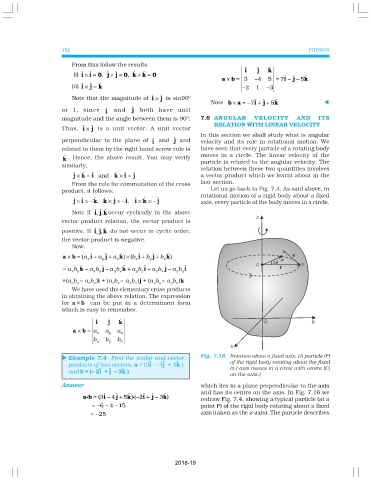
                       u Example 7.4  Find the scalar and vector        Fig. 7.16 Rotation about a fixed axis. (A particle (P)
                                                      ˆ
                                                               ˆ
                                                           ˆ
                         products of two vectors. a = (3i  – 4j + 5k )             of the rigid body rotating about the fixed
                                                                                   (z-) axis moves in a circle with centre (C)
                                    ˆ
                                       ˆ
                                            ˆ
                         and b = (– 2i  + j – 3k  )
                                                                                   on the axis.)
                       Answer                                           which lies in a plane perpendicular to the axis
                                                                        and has its centre on the axis. In Fig. 7.16 we
                                                       ˆ
                                                    ˆ
                                      ˆ
                                                           ˆ
                                              ˆ
                                          ˆ
                                                 −
                                          j
                                              k
                              a b  =  (3 −  4 +  5 ) ( 2 + −  3 )
                                      i
                                i
                                                       j
                                                           k
                                                i
                                                    i
                                                                        redraw Fig. 7.4, showing a typical particle (at a
                                  = − 6 −  4 15                         point P) of the rigid body rotating about a fixed
                                          −
                                 = − 25                                 axis (taken as the z-axis). The particle describes
                                                               2018-19
   161   162   163   164   165   166   167   168   169   170   171