


Page 167 - Class-11-Physics-Part-1_Neat
P. 167
SYSTEMS OF PARTICLES AND ROTATIONAL MOTION                                                 153

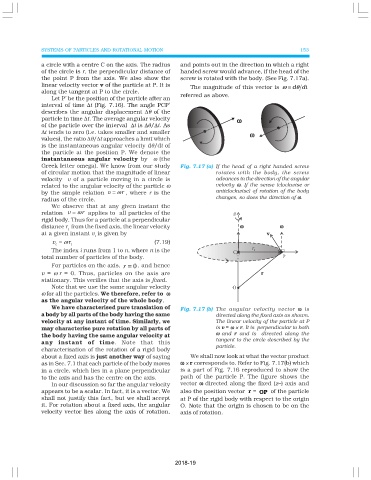
                a circle with a centre C on the axis. The radius  and points out in the direction in which a right
                of the circle is r, the perpendicular distance of  handed screw would advance, if the head of the
                the point P from the axis. We also show the      screw is rotated with the body. (See Fig. 7.17a).
                linear velocity vector v of the particle at P. It is  The magnitude of this vector is  ω =  dθ dt
                along the tangent at P to the circle.
                                                                 referred as above.
                   Let P′ be the position of the particle after an
                interval of time ∆t (Fig. 7.16). The angle PCP′
                describes the angular displacement ∆θ  of the
                particle in time ∆t. The average angular velocity
                of the particle over the interval  ∆t is ∆θ/∆t. As
                ∆t tends to zero (i.e. takes smaller and smaller
                values), the ratio ∆θ/∆t approaches a limit which
                is the instantaneous angular velocity dθ/dt of
                the particle at the position P. We denote the
                instantaneous angular velocity     by  ω  (the
                Greek letter omega). We know from our study      Fig. 7.17 (a) If the head of a right handed screw
                of circular motion that the magnitude of linear              rotates with the body, the screw
                velocity  v  of a particle moving in a circle is             advances in the direction of the angular
                related to the angular velocity of the particle ω            velocity ωω ωω ω. If the sense (clockwise or
                by the simple relation υ = ω r , where r  is the             anticlockwise) of rotation of the body
                radius of the circle.                                        changes, so does the direction of ωω ωω ω.
                   We observe that at any given instant the
                relation   v =  ω r  applies to  all particles of the
                rigid body. Thus for a particle at a perpendicular
                distance r   from the fixed axis, the linear velocity
                         i
                at a given instant v  is given by
                                   i
                    v =  ω r i                          (7.19)
                     i
                   The index i runs from 1 to n, where n is the
                total number of particles of the body.
                                                0 , and hence
                   For particles on the axis,  =r
                v  = ω r = 0. Thus, particles on the axis are
                stationary. This verifies that the axis is fixed.
                   Note that we use the same angular velocity
                ω for all the particles. We therefore, refer to  ωω ωω ω
                as the angular velocity of the whole body.
                   We have characterised pure translation of     Fig. 7.17 (b) The angular velocity vector ωω ωω ω  is
                a body by all parts of the body having the same              directed along the fixed axis as shown.
                velocity at any instant of time. Similarly, we               The linear velocity of the particle at P
                may characterise pure rotation by all parts of               is v = ωω ωω ω × r. It is  perpendicular to both
                the body having the same angular velocity at                 ω ω ω ω ω and r and is  directed along the
                                                                             tangent to the circle described by the
                any instant of time.        Note that this
                                                                             particle.
                characterisation of the rotation of a rigid body
                about a fixed axis is just another way of saying    We shall now look at what the vector product
                as in Sec. 7.1 that each particle of the body moves  ω ω ω ω ω × r corresponds to. Refer to Fig. 7.17(b) which
                in a circle, which lies in a plane perpendicular  is a part of Fig. 7.16 reproduced to show the
                to the axis and has the centre on the axis.      path of the particle P. The figure shows the
                   In our discussion so far the angular velocity  vector ωω ωω ω directed along the fixed (z–) axis and
                appears to be a scalar. In fact, it is a vector. We  also the position vector  r =  OP  of the particle
                shall not justify this fact, but we shall accept  at P of the rigid body with respect to the origin
                it. For rotation about a fixed axis, the angular  O. Note that the origin is chosen to be on the
                velocity vector lies along the axis of rotation,  axis of rotation.


                                                               2018-19

