Page 170 - Class-11-Physics-Part-1_Neat
P. 170
156                                                                                    PHYSICS

                          The physical quantities, moment of a force
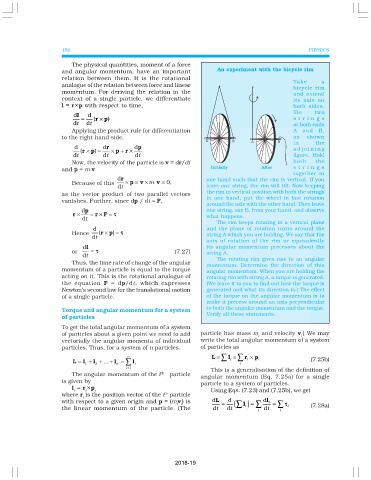
                       and angular momentum, have an important                An experiment with the bicycle rim
                       relation between them. It is the rotational
                                                                                                         Take      a
                       analogue of the relation between force and linear
                                                                                                         bicycle rim
                       momentum. For deriving the relation in the
                                                                                                         and extend
                       context of a single particle, we differentiate                                    its axle on
                       l = r × p with respect to time,                                                   both sides.
                                                                                                         Tie    two
                           dl   d
                              =   ( × p )                                                                s t r i n g s
                                   r
                           dt   dt                                                                       at both ends
                          Applying the product rule for differentiation                                  A  and   B,
                       to the right hand side,                                                           as   shown
                                                                                                         in      the
                           d         dr          dp                                                      a d j o i n i n g
                             ( × p ) =  × p  + r ×
                              r
                           dt         dt         dt                                                      figure.  Hold
                          Now, the velocity of the particle is v = dr/dt                                 both    the
                       and p = m v                                          Initially         After      s t r i n g s
                                                                                                         together in
                                           dr                             one hand such that the rim is vertical. If you
                          Because of this    × p  = v  ×  m v  =  0,
                                           dt                             leave one string, the rim will tilt. Now keeping
                                                                          the rim in vertical position with both the strings
                       as the vector product of two parallel vectors
                                                                          in one hand, put the wheel in fast rotation
                       vanishes. Further, since dp / dt = F,
                                                                          around the axle with the other hand. Then leave
                              d p                                         one string, say B, from your hand, and observe
                           r ×   =  r ×  F = ττ
                              dt                                          what happens.
                                                                              The rim keeps rotating in a vertical plane
                                  d                                       and the plane of rotation turns around the
                          Hence     (r ×  ) p = ττ                        string A which you are holding. We say that the
                                  dt
                                                                          axis of rotation of the rim or equivalently
                              dl                                          its angular momentum precesses about the
                          or     = ττ                          (7.27)     string A.
                              dt
                                                                              The rotating rim gives rise to an angular
                          Thus, the time rate of change of the angular
                                                                          momentum. Determine the direction of this
                       momentum of a particle is equal to the torque      angular momentum. When you are holding the
                       acting on it. This is the rotational analogue of   rotating rim with string A, a torque is generated.
                       the equation F   = dp/dt, which expresses          (We leave it to you to find out how the torque is
                       Newton’s second law for the translational motion   generated and what its direction is.) The effect
                       of a single particle.                              of the torque on the angular momentum is to
                                                                          make it precess around an axis perpendicular
                                                                          to both the angular momentum and the torque.
                       Torque and angular momentum for a system
                                                                          Verify all these statements.
                       of particles
                       To get the total angular momentum of a system
                       of particles about a given point we need to add  particle has mass m  and velocity v ) We may
                                                                                            i
                                                                                                            i
                       vectorially the angular momenta of individual    write the total angular momentum of a system
                       particles. Thus, for a system of n particles,    of particles as
                                              n                             L =   l =   r ×  p
                           L =  l +  l + ... +  l =  ∑ i                       ∑ i   ∑ i    i                  (7.25b)
                                                l
                                                                                      i
                                          n
                                   2
                               1
                                              i  =1
                                                                            This is a generalisation of the definition of
                          The angular momentum of the i    particle     angular momentum (Eq. 7.25a) for a single
                                                          th
                       is given by                                      particle to a system of particles.
                          l  = r  × p
                           i   i   i                                        Using Eqs. (7.23) and (7.25b), we get
                       where r  is the position vector of the i  particle
                                                           th
                              i
                                                                                  d
                       with respect to a given origin and p = (m v ) is     dL  = (∑          dl i
                                                                i  i                   l ) =  ∑   =  ∑  ττ i   (7.28a)
                                                                                        i
                       the linear momentum of the particle. (The            dt   dt           dt
                                                                                            i       i
                                                               2018-19
   165   166   167   168   169   170   171   172   173   174   175