


Page 169 - Class-11-Physics-Part-1_Neat
P. 169
SYSTEMS OF PARTICLES AND ROTATIONAL MOTION                                                 155

                                                                 of the line of action of F  from the origin and
                                                                           θ
                                                                    =
                                                                 F ⊥ ( F  sin ) is the component of F   in the
                                                                 direction perpendicular to r. Note that τ = 0 if
                                                                                          0
                                                                 r = 0, F = 0 or θ = 0 or 180  . Thus, the moment
                                                                                   0
                                                                 of a force vanishes if either the magnitude of
                                                                 the force is zero, or if the line of action of the
                                                                 force passes through the origin.
                                                                    One may note that since  r × F is a vector
                                                                 product, properties of a vector product of two
                                                                 vectors apply to it. If the direction of F  is
                                                                 reversed, the direction of the moment of force
                                                                 is reversed. If directions of both r  and F  are
                                                                 reversed, the direction of the moment of force
                                                                 remains the same.

                                                                 7.7.2 Angular momentum of a particle
                                                                 Just as the moment of a force is the rotational
                                                                 analogue of force in linear motion, the quantity
                                                                 angular momentum is the rotational analogue
                           τ =
                          τ =
                          τ =
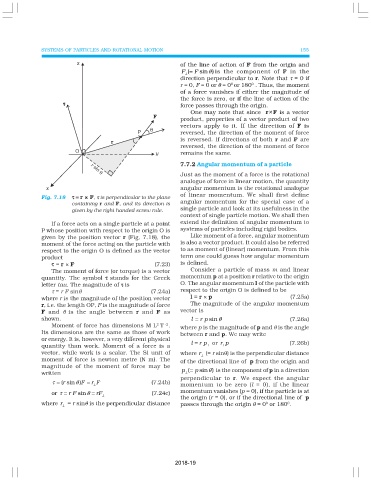
                           τ = r × F, τ τ  τ τ  τ is perpendicular to the plane
                Fig. 7.18  τ =                                   of linear momentum. We shall first define
                          containing r and F, and its direction is  angular momentum for the special case of a
                                                                 single particle and look at its usefulness in the
                          given by the right handed screw rule.
                                                                 context of single particle motion. We shall then
                   If a force acts on a single particle at a point  extend the definition of angular momentum to
                P whose position with respect to the origin O is  systems of particles including rigid bodies.
                given by the position vector r  (Fig. 7.18), the    Like moment of a force, angular momentum
                moment of the force acting on the particle with  is also a vector product. It could also be referred
                respect to the origin O is defined as the vector  to as moment of (linear) momentum. From this
                product                                          term one could guess how angular momentum
                   τ τ τ τ τ = r × F                    (7.23)   is defined.
                   The moment of force (or torque) is a vector      Consider a particle of mass m   and linear
                quantity. The symbol τ τ ττ τ stands for the Greek  momentum p at a position r relative to the origin
                letter tau. The magnitude of τ τ  τ τ  τ is      O. The angular momentum l of the particle with
                   τ = r F sinθ                        (7.24a)   respect to the origin O is defined to be
                where r is the magnitude of the position vector     l = r × p                           (7.25a)
                r, i.e. the length OP, F is the magnitude of force  The magnitude of the angular momentum
                F  and θ  is the angle between r   and F   as    vector is
                shown.                                               l =  r p sinθ                      (7.26a)
                                                         2
                   Moment of force has dimensions M L T .        where p is the magnitude of p and θ is the angle
                                                            -2
                Its dimensions are the same as those of work     between r and p. We may write
                or energy. It is, however, a very different physical  l =
                                                                          ⊥
                                                                                ⊥
                quantity than work. Moment of a force is a              r p  or r p                                   (7.26b)
                vector, while work is a scalar. The SI unit of   where r  (= r sinθ) is the perpendicular distance
                                                                        ⊥
                moment of force is newton metre (N m). The       of the directional line of  p from the origin and
                magnitude of the moment of force may be
                                                                    =
                                                                           θ
                                                                 p  ( p  sin )  is the component of p in a direction
                written                                            ⊥
                                                                 perpendicular to r. We expect the angular
                            θ
                   τ =  ( sin )F =  r F                (7.24b)   momentum to be zero (l = 0), if the linear
                       r
                                  ⊥
                   or τ =  r F  sinθ =  rF ⊥           (7.24c)   momentum vanishes (p = 0), if the particle is at
                                                                 the origin (r = 0), or if the directional line of  p
                where r  = r sinθ is the perpendicular distance  passes through the origin θ = 0  or 180 .
                                                                                                       0
                                                                                               0
                       ⊥


                                                               2018-19

