


Page 201 - Class-11-Physics-Part-1_Neat
P. 201
GRAVITATION                                                                                187

                   This clearly shows that the force due to         The  gravitational force is attractive, i.e., the
                earth’s gravity decreases with distance.  If one  force F is along – r. The force on point mass m
                assumes that the gravitational force due to the                                               1
                                                                 due to m  is of course – F by Newton’s third law.
                earth decreases in proportion to the inverse             2
                                                                 Thus, the gravitational force F  on the body 1
                square of the distance from the centre of the                                  12
                                                                 due to 2 and F  on the body 2 due to 1 are related
                                                                              21
                earth, we will have a  αR  − 2 ; g α R − 2   and we get
                                   m    m       E                as F  = – F .
                                                                            21
                                                                     12
                                                                    Before we can apply Eq. (8.5) to objects under
                      g   R m 2
                        =   2    3600                    (8.4)   consideration, we have to be careful since the
                     a    R
                      m     E                                    law refers to point masses whereas we deal with
                in agreement with a value of g     9.8  m s  and  extended objects which have finite size. If we have
                                                        -2
                the value of a  from Eq. (8.3).  These observations  a collection of point masses, the force on any
                            m
                led Newton to propose the following Universal Law  one of them is the vector sum of the gravitational
                of Gravitation :                                 forces exerted by the other point masses as
                Every body in the universe attracts every other  shown in Fig 8.4.
                body with a force which is directly proportional
                to the product of their masses and inversely
                proportional to the square of the distance
                between them.
                   The quotation is essentially from Newton’s
                famous treatise  called ‘Mathematical Principles
                of Natural Philosophy’ (Principia for short).
                   Stated Mathematically, Newton’s gravitation
                law reads : The force F on a point mass m  due
                                                        2
                to another point mass m  has the magnitude
                                        1
                              m    m
                    | | =F  G   1  2  2                  (8.5)
                                 r
                Equation (8.5) can be expressed in vector form as
                            m    m             m   m
                     F  =  G  1  2  2  ( ) – G=r    1  2  2    r
                                     –
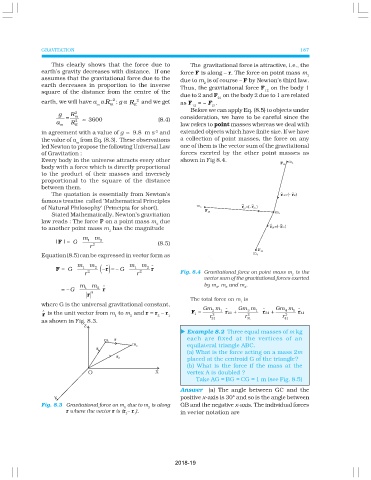
                               r                 r               Fig. 8.4 Gravitational force on point mass m  is the
                                                                                                        1
                                                                         vector sum of the gravitational forces exerted
                             m   m                                       by m , m  and m .
                                                                              2
                                                                                        4
                                                                                 3
                       =  –G   1   2  r
                                 3
                                r
                                                                    The total force on m  is
                where G is the universal gravitational constant,                      1
                                                                         Gm m  1     Gm m   1      Gm m  1
                                                                                         3
                                                                            2
                                                                                                      4
                r    is the unit vector from m  to m  and r = r  – r 1  F 1  =  r  2  r 21 +  r  2     r 31 +  r  2  r 41
                                               2
                                                         2
                                          1
                as shown in Fig. 8.3.                                       21          31            41
                                                                   t  Example 8.2  Three equal masses of m kg
                                                                   each are fixed at the vertices of an
                                                                   equilateral triangle ABC.
                                                                   (a) What is the force acting on a mass 2m
                                                                   placed at the centroid G of the triangle?
                                                                   (b) What is the force if the mass at the
                                O                                  vertex A is doubled ?
                                                                         Take AG = BG = CG = 1 m (see Fig. 8.5)
                                                                 Answer    (a) The angle between GC and the
                                                                 positive x-axis is 30° and so is the angle between
                Fig. 8.3 Gravitational force on m  due to m  is along  GB and the negative x-axis. The individual forces
                                             1       2
                        r where the vector r is (r – r ).        in vector notation are
                                             2   1


                                                               2018-19

