


Page 202 - Class-11-Physics-Part-1_Neat
P. 202
188                                                                                    PHYSICS

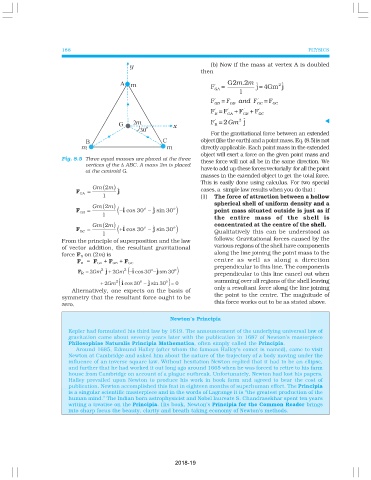
                                                                            (b) Now if the mass at vertex A is doubled
                                                                        then


                                                                                                                    t

                                                                            For the gravitational force between an extended
                                                                        object (like the earth) and a point mass, Eq. (8.5) is not
                                                                        directly applicable. Each point mass in the extended
                                                                        object will exert a force on the given point mass and
                       Fig. 8.5 Three equal masses are placed at the three
                                                                        these force will not all be in the same direction. We
                               vertices of the ∆ ABC. A mass 2m is placed
                               at the centroid G.                       have to add up these forces vectorially  for all the point
                                                                        masses in the extended object to get the total force.
                                                                        This is easily done using calculus. For two special
                                  Gm  (2m )
                            F   =         ˆ j                           cases, a  simple law results when you do that :
                             GA
                                     1                                  (1)  The force of attraction between a hollow
                                  Gm  (2m )                                  spherical shell of uniform density and a
                                            ˆ
                                                       ˆ
                                                    ο
                            F GB  =         ( −i  cos 30 − j  sin 30 ο )     point mass situated outside is just as if
                                     1
                                                                             the entire mass of the shell is
                                  Gm  (2m  )        ο         ο              concentrated at the centre of the shell.
                                                       ˆ
                                            ˆ
                            F   =           ( +i  cos 30 − j  sin 30  )
                             GC                                              Qualitatively this can be understood as
                                     1
                       From the principle of superposition and the law       follows: Gravitational forces caused by the
                       of vector addition, the resultant gravitational       various regions of the shell have components
                       force F R  on (2m) is                                 along the line joining the point mass to the
                                                                             centre as well as along a direction
                             F R   =  F GA  + F GB  + F GC                   prependicular to this line. The components
                                                ˆ

                                                i
                                                       − sin

                              F    = 2Gm 2  ˆ   j    + 2Gm    2  (− cos   30 ο ˆ j      30 ο )

                              R                                              prependicular to this line cancel out when
                                          2  ˆ     ο  ˆ     ο                summing over all regions of the shell leaving
                                                      j
                                            +  2Gm  ( cos i     30 −   sin   30  ) =  0
                                                                             only a resultant force along the line joining
                          Alternatively, one expects on the basis of
                       symmetry that the resultant force ought to be         the point to the centre. The magnitude of
                       zero.                                                 this force works out to be as stated above.
                                                             Newton’s Principia
                         Kepler had formulated his third law by 1619. The announcement of the underlying universal law of
                         gravitation came about seventy years later with the publication in 1687 of Newton’s masterpiece
                         Philosophiae Naturalis Principia Mathematica, often simply called the Principia.
                            Around 1685, Edmund Halley (after whom the famous Halley’s comet is named), came to visit
                         Newton at Cambridge and asked him about the nature of the trajectory of a body moving under the
                         influence of an inverse square law. Without hesitation Newton replied that it had to be an ellipse,
                         and further that he had worked it out long ago around 1665 when he was forced to retire to his farm
                         house from Cambridge on account of a plague outbreak. Unfortunately, Newton had lost his papers.
                         Halley prevailed upon Newton to produce his work in book form and agreed to bear the cost of
                         publication. Newton accomplished this feat in eighteen months of superhuman effort. The Principia
                         is a singular scientific masterpiece and in the words of Lagrange it is “the greatest production of the
                         human mind.” The Indian born astrophysicist and Nobel laureate S. Chandrasekhar spent ten years
                         writing a treatise on the Principia. His book, Newton’s Principia for the Common Reader brings
                         into sharp focus the beauty, clarity and breath taking economy of Newton’s methods.


                                                               2018-19

