


Page 203 - Class-11-Physics-Part-1_Neat
P. 203
GRAVITATION                                                                                189

                (2)  The force of attraction due to a hollow     its neighbouring small sphere.    Due to this
                    spherical shell of uniform density, on a     torque, the suspended wire  gets twisted till such
                    point mass situated inside it is zero.       time as the restoring torque of the wire equals
                    Qualitatively, we can again understand this  the gravitational torque .  If θ is the angle of twist
                    result. Various regions of the spherical shell  of the suspended wire, the restoring torque is
                    attract the point mass inside it in various  proportional to θ, equal to τθ.  Where τ  is the
                    directions. These forces cancel each other   restoring couple per unit angle of twist. τ can be
                    completely.                                  measured independently e.g. by applying a
                                                                 known torque and measuring the angle of twist.
                8.4  THE GRAVITATIONAL CONSTANT                  The gravitational force between the spherical
                                                                 balls is the same as if their masses are
                The value of the gravitational constant G
                                                                 concentrated at their centres.  Thus if d is the
                entering the Universal law of gravitation  can be
                                                                 separation between the centres of the big and
                determined experimentally and this was first
                                                                 its neighbouring small ball, M and m their
                done by English scientist Henry Cavendish in
                                                                 masses, the gravitational force between the big
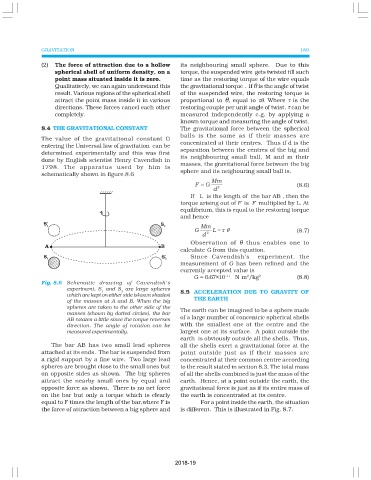
                1798. The apparatus used by him is
                                                                 sphere and its neighouring small ball is.
                schematically shown in figure.8.6
                                                                            Mm
                                                                      F =  G  2                           (8.6)
                                                                             d
                                                                    If   L  is the length of  the bar AB , then the
                                                                 torque arising out of F  is  F  multiplied by L. At
                                                                 equilibrium, this is equal to the restoring torque
                                                                 and hence

                                                                        Mm
                                                                      G   2  L τ θ=                       (8.7)
                                                                         d
                                                                    Observation of θ    thus enables one to
                                                                 calculate G from this equation.
                                                                    Since Cavendish’s       experiment, the
                                                                 measurement of G    has been refined and the
                                                                 currently accepted value is
                                                                                        2
                                                                                 -11
                                                                      G = 6.67×10   N m /kg  2            (8.8)
                Fig. 8.6 Schematic drawing of Cavendish’s
                         experiment. S  and S  are large spheres
                                     1      2                    8.5 ACCELERATION DUE TO GRAVITY OF
                         which are kept on either side (shown shades)
                         of the masses at A and B. When the big       THE EARTH
                         spheres are taken to the other side of the
                                                                 The earth can be imagined to be a sphere made
                         masses (shown by dotted circles), the bar
                         AB rotates a little since the torque reverses  of a large number of concentric spherical shells
                         direction. The angle of rotation can be  with the smallest one at the centre and the
                         measured experimentally.                largest one at its surface.  A point outside the
                                                                 earth  is obviously outside all the shells.  Thus,
                   The bar AB has two small lead spheres         all the shells exert a gravitational force at the
                attached at its ends.  The bar is suspended from  point outside just as if their masses are
                a rigid support by a fine wire.  Two large lead  concentrated at their common centre according
                spheres are brought close to the small ones but  to the result stated in section 8.3. The total mass
                on opposite sides as shown.  The big spheres     of all the shells combined is just the mass of the
                attract the nearby small ones by equal and       earth.  Hence, at a point outside the earth, the
                opposite force as shown.  There is no net force  gravitational force is just as if its entire mass of
                on the bar but only a torque which is clearly    the earth is concentrated at its centre.
                equal to F times the length of the bar,where F is       For a point inside the earth, the situation
                the force of attraction between a big sphere and  is different.  This is illustrated in Fig. 8.7.


                                                               2018-19

