


Page 204 - Class-11-Physics-Part-1_Neat
P. 204
190                                                                                    PHYSICS

                                                                            The acceleration experienced by the mass m,
                                                                        which is usually denoted by the symbol g    is
                                                                        related to F by Newton’s 2  nd  law by relation
                                                                        F = mg. Thus

                                                                                 F   GM
                                                                             g =    =   E                       (8.12)
                                                                                 m    R  2 E
                                                                            Acceleration g is readily measurable.  R is a
                                                                                                                 E
                                                                        known quantity.    The measurement of G    by
                                            M  r                        Cavendish’s experiment (or otherwise), combined
                                                                        with knowledge of g   and R   enables one to
                                                                                                     E
                                                                        estimate M  from Eq. (8.12).  This is the reason
                                                                                   E
                                                                        why there is a popular statement regarding
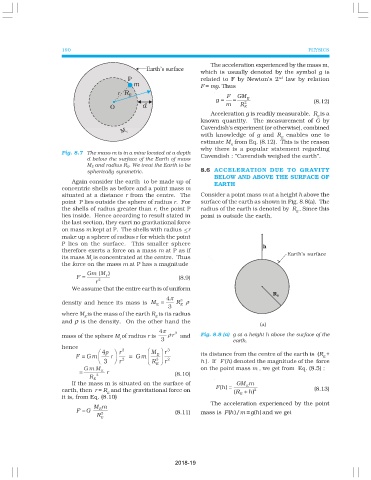
                       Fig. 8.7 The mass m is in a mine located at a depth  Cavendish : “Cavendish weighed the earth”.
                                d below the surface of the Earth of mass
                                M E  and radius R E . We treat the Earth to be
                                spherically symmetric.                  8.6 ACCELERATION DUE TO GRAVITY
                                                                             BELOW AND ABOVE THE SURFACE OF
                          Again consider the earth  to be made up of
                                                                             EARTH
                       concentric shells as before and a point mass m
                       situated at a distance r  from the centre.  The  Consider a point mass m at a height h above the
                       point  P lies outside the sphere of radius r.  For  surface of the earth as shown in Fig. 8.8(a).  The
                       the shells of radius greater than r, the point P  radius of the earth is denoted by  R . Since this
                                                                                                          E
                       lies inside.  Hence according to result stated in  point is outside the earth,
                       the last section, they exert no gravitational force
                       on mass m kept at P.  The shells with radius  ≤ r
                       make up a sphere of radius r for which the point
                       P lies on the surface.   This smaller sphere
                       therefore exerts a force on a mass m at P as if
                       its mass M is concentrated at the centre.  Thus
                                 r
                       the force on the mass m at P has a magnitude
                                Gm  (M  )
                            F =       r                         (8.9)
                                   r  2
                          We assume that the entire earth is of uniform
                                                            4π
                                                                 3
                       density and hence its mass is M =       R ρ
                                                                 E
                                                        E
                                                             3
                       where M is the mass of the earth R  is its radius
                               E                        E
                       and ρ  is the density.  On the other hand the
                                                         4π    3
                       mass of the sphere M of radius r is   ρ r  and   Fig. 8.8 (a) g at a height h above the surface of the
                                           r              3                         earth.
                       hence
                                                                        its distance from the centre of the earth is  (R +
                                                                                                                   E
                                                                        h ).  If   F (h) denoted the magnitude of the  force
                               G m M                                    on the point mass m , we get from  Eq. (8.5) :
                             =       E  r                      (8.10)
                                 R  E  3
                          If the mass m is situated on the surface of                GM m
                                                                             F ( ) =    E                       (8.13)
                                                                               h
                       earth, then  r = R  and the gravitational force on                  2
                                       E                                            (R +  h  )
                                                                                      E
                       it is, from Eq. (8.10)
                                                                            The acceleration experienced by the point
                                  M m
                            F =  G  E 2                        (8.11)   mass is  ( )/F h  m ≡  g ( )and we get
                                                                                            h
                                   R
                                     E


                                                               2018-19

