


Page 206 - Class-11-Physics-Part-1_Neat
P. 206
192 PHYSICS
If we associate a potential energy W(h) at a We have calculated the potential energy at
point at a height h above the surface such that a point of a particle due to gravitational forces
on it due to the earth and it is proportional to
W(h) = mgh + W (8.21)
o the mass of the particle. The gravitational
(where W = constant) ;
o potential due to the gravitational force of the
then it is clear that
earth is defined as the potential energy of a
W = W(h ) – W(h ) (8.22)
12 2 1 particle of unit mass at that point. From the
The work done in moving the particle is just
earlier discussion, we learn that the gravitational
the difference of potential energy between its
potential energy associated with two particles
final and initial positions.Observe that the
of masses m and m separated by distance by a
constant W cancels out in Eq. (8.22). Setting 1 2
o distance r is given by
h = 0 in the last equation, we get W ( h = 0 ) =
W . h = 0 means points on the surface of the Gm m
o. V = – 1 2 (if we choose V = 0 as r → ∞ )
earth. Thus, W is the potential energy on the r
o
surface of the earth. It should be noted that an isolated system
If we consider points at arbitrary distance of particles will have the total potential energy
from the surface of the earth, the result just that equals the sum of energies (given by the
derived is not valid since the assumption that above equation) for all possible pairs of its
the gravitational force mg is a constant is no constituent particles. This is an example of the
longer valid. However, from our discussion we application of the superposition principle.
know that a point outside the earth, the force of
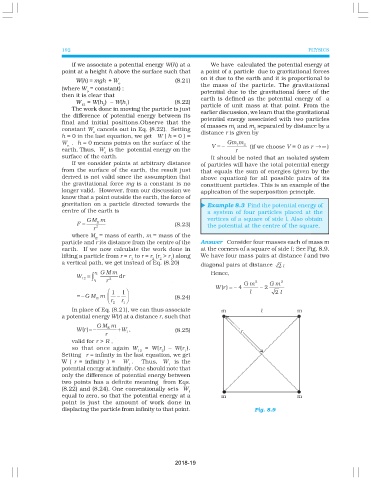
gravitation on a particle directed towards the t Example 8.3 Find the potential energy of
centre of the earth is a system of four particles placed at the
G M m vertices of a square of side l. Also obtain
F = 2 E (8.23) the potential at the centre of the square.
r
where M = mass of earth, m = mass of the
E
particle and r its distance from the centre of the Answer Consider four masses each of mass m
earth. If we now calculate the work done in at the corners of a square of side l; See Fig. 8.9.
lifting a particle from r = r to r = r (r > r ) along We have four mass pairs at distance l and two
1 2 2 1
a vertical path, we get instead of Eq. (8.20)
diagonal pairs at distance 2 l
G M m
r 2 Hence,
12 ∫
W = d r
r 1 r 2 G m 2 G m 2
W r = − 2
−
( ) 4
1 1 l 2 l
= −G M m −
E (8.24)
r 2 r 1
In place of Eq. (8.21), we can thus associate
a potential energy W(r) at a distance r, such that
G M m
W ( ) r =− E + W 1 , (8.25)
r
valid for r > R ,
so that once again W = W(r ) – W(r ).
12 2 1
Setting r = infinity in the last equation, we get
W ( r = infinity ) = W . Thus, W is the
1 1
potential energy at infinity. One should note that
only the difference of potential energy between
two points has a definite meaning from Eqs.
(8.22) and (8.24). One conventionally sets W
1
equal to zero, so that the potential energy at a
point is just the amount of work done in
displacing the particle from infinity to that point. Fig. 8.9
2018-19

