Page 207 - Class-11-Physics-Part-1_Neat
P. 207
GRAVITATION                                                                                193

                                                                 Thus, the minimum speed required for an object
                           2 G  m 2    1    G  m 2
                     =  −           2    +     =  −   5.41    to reach infinity (i.e. escape from the earth)
                           l       2          l                corresponds to
                   The gravitational potential at the centre of       1      2     GmM
                                                                          ( )
                                                                        m V i     =     E                (8.30)
                the square  (r =  2 l /  ) 2  is                      2       min  h +  R  E
                                                                    If the object is thrown from the surface of
                               G     m
                      )
                   U( r  =  −  4    2                            the earth, h = 0, and we get
                                l  .                        t
                                                                                2GM
                                                                       V
                8.8  ESCAPE SPEED                                     ( ) min  =     E                   (8.31)
                                                                        i
                                                                                  R E
                If a stone is thrown by hand, we see it falls back
                                                                                                  2
                to the earth. Of course using machines we can       Using the relation  g =  GM  E  /R , we get
                                                                                                  E
                shoot an object with much greater speeds and
                with greater and greater initial speed, the object    ( )    =  2gR E                    (8.32)
                                                                       V
                                                                        i
                scales higher and higher heights. A natural               min
                query that arises in our mind is the following:     Using the value of g  and R , numerically
                                                                                                E
                ‘can we throw an object with such high initial   (V ) i min ≈11.2 km/s. This is called the escape
                speeds that it does not fall back to the earth?’  speed, sometimes loosely called the escape
                   The principle of conservation of energy helps  velocity.
                us to answer this question. Suppose the object      Equation (8.32) applies equally well to an
                did reach infinity and that its speed there was  object thrown from the surface of the moon with
                V . The energy of an object is the sum of potential  g replaced by the acceleration due to Moon’s
                 f                                               gravity on its surface and r  replaced by the
                and kinetic energy. As before W  denotes that                                E
                                               1                 radius of the moon. Both are smaller than their
                gravitational potential energy of the object at
                infinity. The total energy of the projectile at  values on earth and the escape speed for the
                infinity then is                                 moon turns out to be 2.3 km/s, about five times
                                                                 smaller. This is the reason that moon has no
                                                                 atmosphere. Gas molecules if formed on the
                                    2
                                 mV
                     E  ( ) W∞ =  1  +  f               (8.26)   surface of the moon having velocities larger than
                                  2                              this will escape the gravitational pull of the
                   If the object was thrown initially with a speed  moon.
                V  from a point at a distance (h+R ) from the
                 i                                E                t
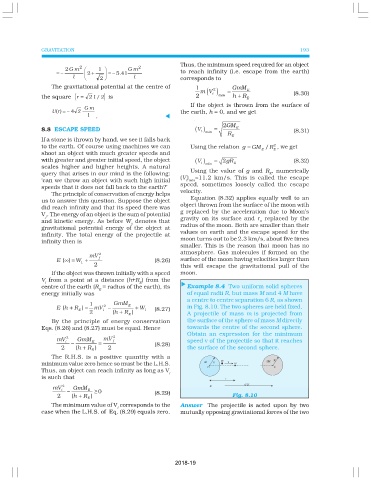
                centre of the earth (R  = radius of the earth), its  Example 8.4  Two uniform solid spheres
                                    E
                energy initially was                               of equal radii R, but mass M and 4 M have
                                                                   a centre to centre separation 6 R, as shown
                                 1       GmM  E
                     E  (h +  R  E  ) =  mV i 2  –  +  W 1  (8.27)  in Fig. 8.10. The two spheres are held fixed.
                                 2       (h +  R  )
                                               E                   A projectile of mass m is projected from
                   By the principle of energy conservation         the surface of the sphere of mass M directly
                Eqs. (8.26) and (8.27) must be equal. Hence        towards the centre of the second sphere.
                                                                   Obtain an expression for the minimum
                                         2
                     mV  2  GmM       mV f                         speed v of the projectile so that it reaches
                        i
                          –       E  =                  (8.28)
                       2    (h +  R  )  2                          the surface of the second sphere.
                                 E
                   The R.H.S. is a positive quantity with a
                minimum value zero hence so must be the L.H.S.
                Thus, an object can reach infinity as long as V
                                                             i
                is such that
                    mV i 2  GmM E
                         –        ≥  0                  (8.29)
                     2    (h +  R  )                                               Fig. 8.10
                                E
                   The minimum value of V  corresponds to the    Answer    The projectile is acted upon by two
                                           i
                case when the L.H.S. of  Eq. (8.29) equals zero.  mutually opposing gravitational forces of the two


                                                               2018-19
   202   203   204   205   206   207   208   209   210   211   212