


Page 89 - Class-11-Physics-Part-1_Neat
P. 89
MOTION IN A PLANE 75
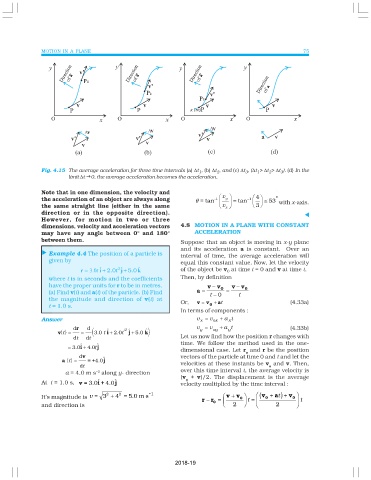
x (m)
Fig. 4.15 The average acceleration for three time intervals (a) ∆t , (b) ∆t , and (c) ∆t , (∆t > ∆t > ∆t ). (d) In the
2
3
3
1
1
2
limit ∆t g0, the average acceleration becomes the acceleration.
Note that in one dimension, the velocity and
1 4
the acceleration of an object are always along θ = tan v y = tan − ≅ 53 ° with x-axis.
-1
the same straight line (either in the same v x 3
direction or in the opposite direction). t
However, for motion in two or three
dimensions, velocity and acceleration vectors 4.8 MOTION IN A PLANE WITH CONSTANT
may have any angle between 0° and 180° ACCELERATION
between them.
Suppose that an object is moving in x-y plane
and its acceleration a is constant. Over an
Example 4.4 The position of a particle is
interval of time, the average acceleration will
t
given by
equal this constant value. Now, let the velocity
ˆ
ˆ
5
2
r = 3.0t i + .0t 2 ˆ j + .0 k of the object be v at time t = 0 and v at time t.
0
where t is in seconds and the coefficients Then, by definition
have the proper units for r to be in metres. v − v 0 v − v 0
(a) Find v(t) and a(t) of the particle. (b) Find a = =
t − 0 t
the magnitude and direction of v(t) at
Or, v = v + at (4.33a)
t = 1.0 s. 0
In terms of components :
Answer v x = v ox + a t
x
d r d 2 v = v oy + a t (4.33b)
y
y
v ( ) t = = ( 3.0 i t + 2.0 t j + 5.0 ) k
t d t d Let us now find how the position r changes with
time. We follow the method used in the one-
t
= 3.0i + .0 j
4
dimensional case. Let r and r be the position
o
d v vectors of the particle at time 0 and t and let the
a ( ) t = = +4.0 j
t d velocities at these instants be v and v. Then,
o
over this time interval t, the average velocity is
a = 4.0 m s along y- direction
–2
(v o + v)/2. The displacement is the average
ˆ
At t = 1.0 s, v = 3.0i + 4.0j ˆ velocity multiplied by the time interval :
2
at
It’s magnitude is = 3v 2 + 4 = 5.0 m s 1 - r − r = v + v t = ( v + ) + v t
0
0
0
and direction is 0 2 2
2018-19

