


Page 33 - The Atlas of Economic Complexity
P. 33
34  |  THE ATLAS OF ECONOMIC COMPLEXITY


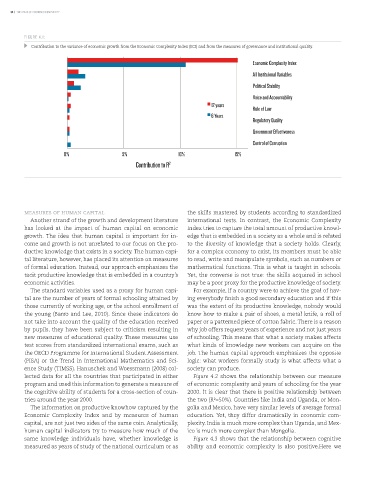
          FIGURE 4.1:
             Contribution to the variance of economic growth from the Economic Complexity Index (ECI) and from the measures of governance and institutional quality.


                                                                                               Economic Complexity Index
                                                                                               All Instituional Variables

                                                                                               Political Stability

                                                                                               Voice and Accountability
                                                                                12 years
                                                                                               Rule of Law
                                                                                6 Years
                                                                                               Regulatory Quality

                                                                                               Government Effectiveness
                                                                                               Control of Corruption

                         0%                   5%                   10%                  15%
                                                    Contribution to R 2


          measures of human capital                                    the skills mastered by students according to standardized
            Another strand of the growth and development literature    international  tests.  In  contrast,  the  Economic  Complexity
          has  looked  at  the  impact  of  human  capital  on  economic   Index tries to capture the total amount of productive knowl-
          growth. The  idea  that  human  capital  is  important  for  in-  edge that is embedded in a society as a whole and is related
          come and growth is not unrelated to our focus on the pro-    to  the  diversity  of  knowledge  that  a  society  holds.  Clearly,
          ductive knowledge that exists in a society. The human capi-  for a complex economy to exist, its members must be able
          tal literature, however, has placed its attention on measures   to read, write and manipulate symbols, such as numbers or
          of formal education. Instead, our approach emphasizes the    mathematical functions. This is what is taught in schools.
          tacit productive knowledge that is embedded in a country’s   Yet, the converse is not true: the skills acquired in school
          economic activities.                                         may be a poor proxy for the productive knowledge of society.
            The standard variables used as a proxy for human capi-       For example, if a country were to achieve the goal of hav-
          tal are the number of years of formal schooling attained by   ing everybody finish a good secondary education and if this
          those currently of working age, or the school enrollment of   was the extent of its productive knowledge, nobody would
          the young (Barro and Lee, 2010). Since these indicators do   know how to make a pair of shoes, a metal knife, a roll of
          not take into account the quality of the education received   paper or a patterned piece of cotton fabric. There is a reason
          by pupils, they have been subject to criticism resulting in   why job offers request years of experience and not just years
          new measures of educational quality. These measures use      of schooling. This means that what a society makes affects
          test scores from standardized international exams, such as   what kinds of knowledge new workers can acquire on the
          the OECD Programme for International Student Assessment      job. The human capital approach emphasizes the opposite
          (PISA) or the Trend in International Mathematics and Sci-    logic: what workers formally study is what affects what a
          ence Study (TIMSS). Hanuschek and Woessmann (2008) col-      society can produce.
          lected data for all the countries that participated in either   Figure  4.2  shows  the  relationship  between  our  measure
          program and used this information to generate a measure of   of economic complexity and years of schooling for the year
          the cognitive ability of students for a cross-section of coun-  2000. It is clear that there is positive relationship between
          tries around the year 2000.                                  the two (R =50%). Countries like India and Uganda, or Mon-
                                                                                 2
            The information on productive knowhow captured by the      golia and Mexico, have very similar levels of average formal
          Economic  Complexity  Index  and  by  measures  of  human    education. Yet,  they  differ  dramatically  in  economic  com-
          capital, are not just two sides of the same coin. Analytically,   plexity. India is much more complex than Uganda, and Mex-
          human capital indicators try to measure how much of the      ico is much more complex than Mongolia.
          same  knowledge  individuals  have,  whether  knowledge  is    Figure 4.3 shows that the relationship between cognitive
          measured as years of study of the national curriculum or as   ability  and  economic  complexity  is  also  positive.Here  we

