


Page 34 - The Atlas of Economic Complexity
P. 34
MAPPING PATHS TO PROSPERITY  |  35


                  FIGURE 4.2:                                                  FIGURE 4.3:
                     Relationship between Years of Schooling and the Economic Complexity Index   Relationship between Cognitive Ability and the Economic Complexity Index (ECI)
                     (ECI) for the year 2000.                                    for the year 2000.

                                                              JPN                                                                   JPN
                                                          DEU
                                                         CHE                                                                    CHE
                        2                              GBR    SWE  USA              2                                    USA  GBR SWE
                                                     FIN                                                                      FRA  FIN
                                                     AUT  FRA                                                                IRL  AUT
                                                           BEL  IRL  CZE                                                  DNK  BEL CZE
                                                      ITA  DNK                                                           ITA
                                                  SGP     NLD  SVK                                                         SVN  NLD  SGP
                                                     SVN  ESP POL  CAN UKR KOR  HUN ISR NOR  1            MEX           ISR NOR  ESP  CAN SVK HUN  KOR
                    Economic Complexity Index  0  MOZ MLI  IND  IDN  VEN  TUN EGY PRY QAT COL SAU GAB ZAF PRT ARE PHL JOR HRV ARG LVA MYS PAN GRC HKG BGR LTU  ROU  EST  AUS  NZL  Economic Complexity Index  0  ZAF PER  PHL  BRA SAU ALB TUN  IDN  EGY LBN ZWE TUR MKD JOR  IND URY  THA  MDA PRT GRC LTU  BGR MYS  CHN NZL  AUS  EST
                                                                                                                           POL
                        1
                                                   MEX
                                                         RUS
                                                                                                                            RUS
                                               BRA
                                                                                                                                  HKG
                                                                                                          CHL COL
                                              THA
                                                                                                      ARG
                                                 CHN URY
                                                       CHL
                                              TUR
                                                                                                                          LVA
                                                          KAZ
                                                     KGZ TTO
                                                          ALB
                                                    PER
                                              IRN LBY
                                                 ECU
                        −1         LBR MRT SEN GTM PAK MAR  BGD SYR  VNM KWT ZMB  DZA KEN  SLV MUS ZWE GHA LKA CRI MNG  BOL  JAM  TJK CUB  1  MAR  GHA  KWT  IRN
                                            COG
                                     CIV  LAO  HND                                  -
                                YEM  SDN  PNG  TZA  NIC  KHM
                                        UGA                                                                  NGA
                                     MWI    CMR
                        −2                                                          2
                                                                                    _
                         0                5               10              15         3        3.5        4        4.5        5        5.5
                                           Years of schooling                                          Cognitive Ability
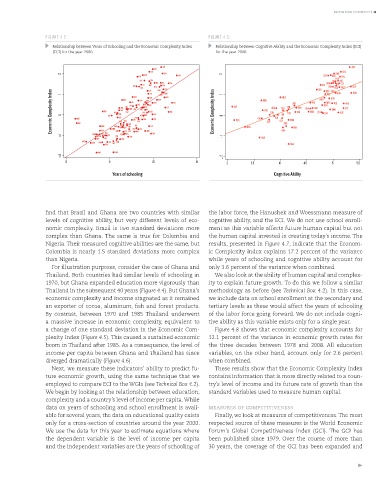
                  find that Brazil and Ghana are two countries with similar    the labor force, the Hanushek and Woessmann measure of
                  levels  of  cognitive  ability,  but  very  different  levels  of  eco-  cognitive ability, and the ECI. We do not use school enroll-
                  nomic  complexity.  Brazil  is  two  standard  deviations  more   ment as this variable affects future human capital but not
                  complex  than  Ghana. The  same  is  true  for  Colombia  and   the human capital invested in creating today’s income. The
                  Nigeria. Their measured cognitive abilities are the same, but   results, presented in Figure 4.7, indicate that the Econom-
                  Colombia is nearly 1.5 standard deviations more complex      ic Complexity Index explains 17.2 percent of the variance
                  than Nigeria.                                                while years of schooling and cognitive ability account for
                    For illustration purposes, consider the case of Ghana and   only 3.6 percent of the variance when combined.
                  Thailand. Both countries had similar levels of schooling in    We also look at the ability of human capital and complex-
                  1970, but Ghana expanded education more vigorously than      ity to explain future growth. To do this we follow a similar
                  Thailand in the subsequent 40 years (Figure 4.4). But Ghana’s   methodology as before (see Technical Box 4.2). In this case,
                  economic complexity and income stagnated as it remained      we include data on school enrollment at the secondary and
                  an exporter of cocoa, aluminum, fish and forest products.    tertiary levels as these would affect the years of schooling
                  By  contrast,  between  1970  and  1985  Thailand  underwent   of the labor force going forward. We do not include cogni-
                  a  massive  increase  in  economic  complexity,  equivalent  to   tive ability as this variable exists only for a single year.
                  a change of one standard deviation in the Economic Com-        Figure 4.8 shows that economic complexity accounts for
                  plexity Index (Figure 4.5). This caused a sustained economic   12.1 percent of the variance in economic growth rates for
                  boom in Thailand after 1985. As a consequence, the level of   the  three  decades  between  1978  and  2008.  All  education
                  income per capita between Ghana and Thailand has since       variables, on the other hand, account only for 2.6 percent
                  diverged dramatically (Figure 4.6).                          when combined.
                    Next, we measure these indicators’ ability to predict fu-    These results show that the Economic Complexity Index
                  ture economic growth, using the same technique that we       contains information that is more directly related to a coun-
                  employed to compare ECI to the WGIs (see Technical Box 4.2).   try’s level of income and its future rate of growth than the
                  We begin by looking at the relationship between education,   standard variables used to measure human capital.
                  complexity and a country’s level of income per capita. While
                  data on years of schooling and school enrollment is avail-   measures of competitiveness
                  able for several years, the data on educational quality exists   Finally, we look at measures of competitiveness. The most
                  only for a cross-section of countries around the year 2000.   respected source of these measures is the World Economic
                  We use the data for this year to estimate equations where    Forum’s  Global  Competitiveness  Index  (GCI).  The  GCI  has
                  the  dependent  variable  is  the  level  of  income  per  capita   been  published  since  1979.  Over  the  course  of  more  than
                  and the independent variables are the years of schooling of   30 years, the coverage of the GCI has been expanded and

